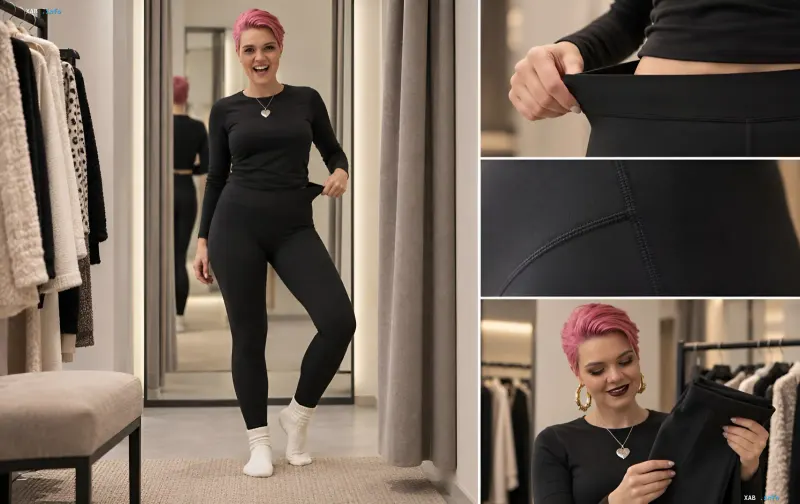
When choosing thermal underwear, it is easy to focus exclusively on the thickness of the fabric and its ability to retain heat. However, as stylist Olena Shevchenko emphasizes on her Instagram, it is equally important whether such underwear is comfortable to move in, walk around in during the day, and use the restroom outside the home. The Styler project (RБК-Україна) has gathered five practical recommendations to help avoid common inconveniences and make your purchase genuinely useful for everyday wear.
Why a bodysuit is not always a practical solution
At first glance, thermal underwear in the form of a bodysuit seems ideal: the top and bottom are connected into a single garment, so the lower back is not exposed during movement. However, in everyday use, this design creates a number of inconveniences. The stylist advises opting for a separate set consisting of a long-sleeve top and leggings. This is especially relevant if you plan to spend a lot of time away from home: in a shopping mall or on the road, a bodysuit has to be removed or unfastened to use the restroom, whereas with two separate pieces, everything is much simpler and faster.
The waistband: a wide, soft band instead of a narrow one
Another detail that is definitely worth checking during a fitting is the waistband on the leggings. If the band is too narrow and tight, it can dig into the abdomen, especially when you sit or bend over. In addition, a narrow band often twists into a cord, causing the underwear to pinch and requiring constant adjustment. It is better to choose a wide and soft band that fits evenly against the body: it securely holds the leggings in place without creating a feeling of compression.
High-rise fit against sliding down
Thermal underwear often serves as the base layer under jeans, insulated trousers, or a winter jumpsuit. If the leggings do not have a sufficiently high rise, they can slide down during walking, bending, and squatting. As a result, you have to constantly pull up the waistband, and the lower back remains insufficiently covered. The stylist recommends choosing high-rise leggings and, during the fitting, walking, squatting, and bending over to make sure the waistband stays in place and does not create discomfort in the abdomen.
Flat seams and gusset: details that make a difference
Even soft fabric does not guarantee comfort if the product's construction is flawed. Bulky seams can be felt under outer clothing and chafe the skin in areas of constant contact with the body — especially in the hip area if the thermal underwear is worn for many hours straight or combined with tight trousers. When choosing, you should inspect the inside of the garment and check whether the seams protrude above the fabric surface: flat seams are generally more comfortable for long-term wear because they protrude less and reduce the risk of chafing. The gusset deserves special attention — an additional insert in the lower part of the underwear, in the crotch area, which can be diamond-shaped. A properly constructed gusset promotes a more comfortable fit in the groin area and helps avoid situations where fabric gathers between the legs or leggings slide down during movement. This element can also be found in ordinary tights, so before buying, it is worth checking if such an insert exists and whether it creates excessive tension during fitting.
Size and material: final check
For thermal underwear to be comfortable for daily wear, it is also important to choose the right size: the garment should fit snugly against the body without squeezing it or restricting movement. Thermal insulation and moisture-wicking depend primarily on the material and the specific features of the product, so when choosing, you should consider what tasks the underwear is being bought for — daily wear as an insulating layer or active sports. Following the five principles described — a separate set, a wide waistband, a high rise, flat seams with a gusset, and the correct size — will help avoid most typical problems and make thermal underwear a truly comfortable companion for the cold season.