A smooth glass ceramic cooktop is one of the most convenient solutions for a modern kitchen, yet it requires a special approach to maintenance. Grease stains, cookware marks, and burned food residue accumulate quickly, and improper cleaning can leave scratches that are impossible to fix. The article by Styler (a RBC-Ukraine project) gathers recommendations from leading kitchen appliance manufacturers — Bosch, BORA, SCHOTT CERAN, GE Appliances — as well as advice from publications like This Old House, Martha Stewart, and Good Housekeeping on the safe care of glass ceramics.
Daily Care: Microfiber and Mild Agents
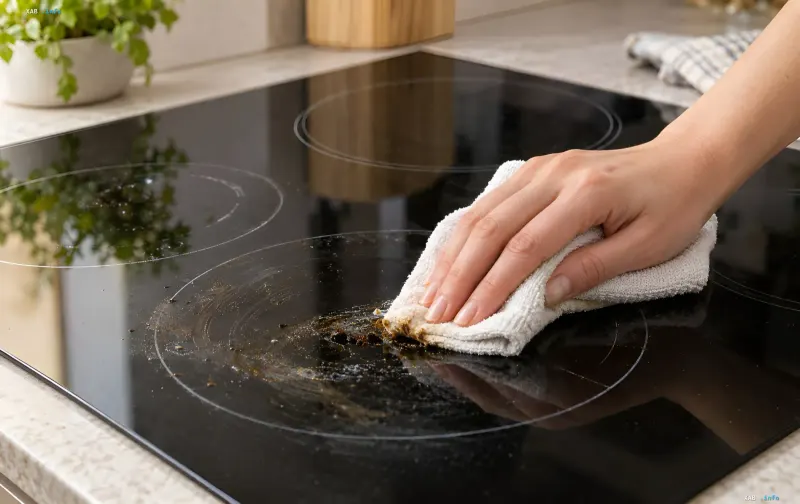
According to recommendations from This Old House, cleaning a glass ceramic surface requires soft materials and appropriate cleaning agents. For daily cleaning of light dirt, a damp microfiber cloth and a small amount of neutral detergent are generally sufficient. Kitchen appliance manufacturer BORA advises cleaning the glass ceramic surface after every use once it has completely cooled down. Regular maintenance helps prevent grease buildup and food burning, which significantly simplifies deep cleaning in the long run.
Scraper for Burned-On Residue: Angle and Pressure
If dried or burned-on residue remains on the surface, Bosch recommends using a special glass ceramic scraper. The key rule: the scraper should be held at a shallow angle — approximately 20 to 30 degrees. A larger angle increases the risk of scratching. At the time, it is important to follow the instructions provided with the specific scraper and cooktop model. You should never press hard on the tool or try to pry up dirt with its sharp corner. A regular kitchen knife or any other sharp objects are not suitable for such cleaning and can permanently damage the surface.
Mineral Deposits and White Residue: What to Do
According to Martha Stewart Living, white or cloudy residue on glass ceramics can appear for several reasons. The first step is to clean the cooled surface with a microfiber cloth dampened with warm water and a little detergent. If the residue does not come off, it is recommended to use a special glass ceramic cleaner. For certain types of mineral deposits, white vinegar may be permitted, but only if explicitly allowed by the manual for your specific cooktop. It is important to understand: not all marks can be eliminated by simple washing. If the surface already has micro-scratches or other damage, regular cleaners will not restore its original appearance.
Hot Surfaces: Special Rules and Risks
According to glass ceramic manufacturer SCHOTT CERAN, certain substances must be removed from a hot surface without waiting for it to cool down. If such substances are left until they cool, they can cause irreversible damage to the glass ceramics. At the same time, it is important not to use wet wipes for regular washing of a hot burner — this can lead to burns. If you cannot safely remove a molten substance, specialists warn: do not risk it. Hot glass ceramics and molten materials can cause severe burns. Do not apply regular cleaners to a hot cooktop: detergent residue can burn on and form stubborn stains.
What Absolutely Not to Do
Good Housekeeping emphasizes that even strong glass ceramics remain vulnerable to abrasive cleaning. Ordinary glass cleaners should also be approached with caution: some cooktop manufacturers allow their use, while others recommend exclusively specialized cleaners. Before using any new product, check the cooktop manual. Do not attempt to polish out scratches with baking soda or abrasive pastes — such "cleaning" can only worsen the condition of the surface. GE Appliances warns that even scratch-resistant glass ceramics can be damaged by improper cookware use, particularly heavy cast iron, whose rough bottom leaves scratches when moved across the cooktop.
Damage is Already Present: What Next
If scratches have already appeared on the glass ceramics, they cannot be completely removed by regular cleaning. In case the glass ceramic has cracked, the cooktop must not be used until repaired: such a surface requires inspection and intervention by specialists. Ignoring a crack can lead to further panel failure and create safety hazards. Thus, the main principle of glass ceramic cooktop care is regularity and gentleness: daily wiping after cooling, special products, and the correct scraper can keep the surface looking flawless for years.