Creases on leather shoes do not appear because of poor product quality, but due to the very nature of the material. Genuine leather is flexible and changes shape during movement: when a person walks, the upper part of the shoe constantly bends, and characteristic folds gradually form in the toe area. According to the Leather Naturally organization, minor creases on genuine leather are a normal phenomenon, and proper care helps maintain the material's elasticity. It is not always possible to completely remove deep folds, but surface creases can be made noticeably less pronounced if you act carefully and avoid aggressive methods.
Where to Start: Cleaning and Moisturizing
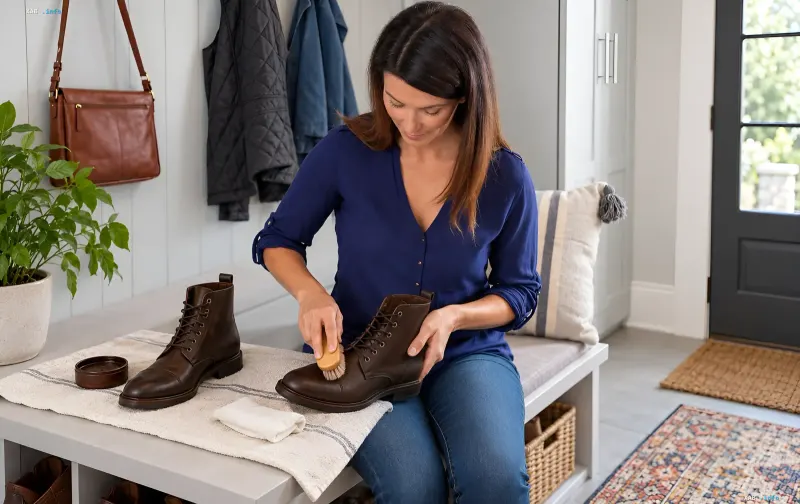
It is safest to start not with heating, but with surface preparation. Shoes should be cleaned with a soft, dry brush or a clean cloth, and if there is dirt, a special cleaner for the corresponding type of leather should be used. It is important not to rub crease areas with force: intensive mechanical friction can damage the finish and leave scuffs. If the shoes are wet, they must first be allowed to dry naturally. After cleaning, a suitable conditioner or balm is applied to smooth genuine leather, which maintains elasticity and reduces the risk of drying out. Shoe manufacturer Clarks recommends applying the balm with a clean cloth and then gently polishing the surface. Before doing this, the product should be tested on an inconspicuous area: if the color and finish do not change undesirably, it is distributed in a thin layer, paying attention to the folds without stretching or bending the leather too much. Excess cream can leave stickiness, uneven gloss, or change the shade.
Shoe Trees and Paper to Maintain Shape
Another way to reduce the depth of creases is to use special shoe trees, which are inserts that support the shape of the shoes during storage. According to Clarks' recommendations, they are especially useful for classic leather shoes and boots: it is important that they support the front part without stretching the material. If there are no special inserts, you can stuff the shoes with clean, soft paper for temporary shape maintenance. However, do not stuff them too tightly: excessive pressure can deform the leather or stretch the upper part.
What Not to Do: Iron, Steam, and Hairdryer
Social media is full of advice on smoothing leather shoes with a hot iron through a towel or heating creases with a hairdryer. Clarks' recommendations, cited by Styler, emphasize that leather shoes should be dried at room temperature, away from radiators, heaters, and hairdryers. Excessive heating can overdry genuine leather, make it stiffer, and lead to cracks, while high temperatures can affect adhesive bonds and the decorative finish. At the same time, other publications, citing Nike, call the iron a “popular but risky” method that is permissible if conditions are met: stuffing the shoes with paper and never placing the iron directly on the material. Thus, sources' approaches differ, and the most conservative and safest position is not to use heat on your own.
Different Materials Require Different Care
The approach to creases depends on the type of leather. Smooth genuine leather requires special creams, balms, and shoe trees, while it is important to consider the type of finish and the manufacturer's recommendations. Suede and nubuck do not tolerate regular smooth leather creams: they can leave stains and change the texture, so separate brushes and products are needed for these materials. Patent leather with a glossy finish requires separate care — heavy balms and intensive polishing may not be suitable. For synthetic leather, when deep folds, cracks, or coating peeling appear, a regular conditioner generally does not solve the problem.
When to Consult a Professional
If the folds are very deep, it is wiser to entrust the restoration to a leather shoe repair and restoration specialist. The master will be able to assess the condition of the material and determine whether restoration is possible without the risk of damaging the product. In other cases, regular and proper care — cleaning, moderate moisturizing, and maintaining shape — allows you to preserve the neat appearance of the shoes and make creases less noticeable for a long time.