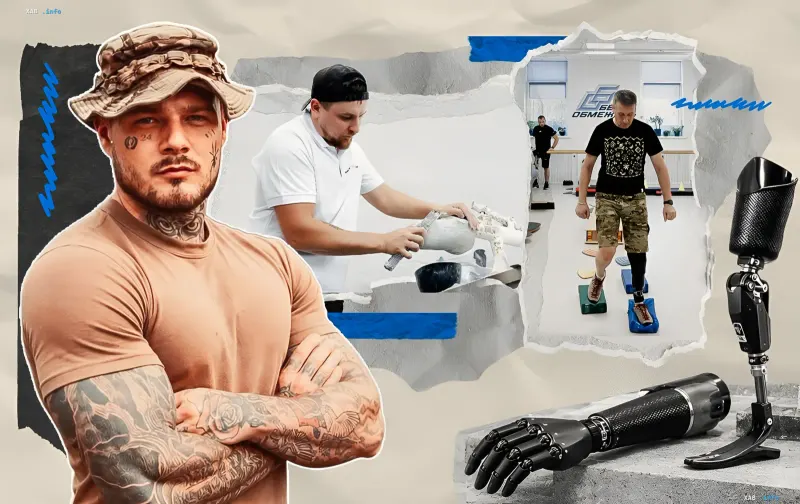
In Ukraine, thousands of people who have undergone limb amputations are learning to live all over again. Modern prostheses allow them to return to their usual rhythm of life, work, play sports, and even serve in the military. However, the path to recovery begins long before the first steps on a prosthesis — passing through casts, adjustments, phantom pain, and months of rehabilitation. A RBC-Ukraine correspondent visited the Bez Obmezhen ("Without Limits") prosthetic center network in Kyiv to find out how people travel the path from their first cast to a full life with a prosthesis.
The commander who never took off his uniform
Every day, a British volunteer named Rhys, with the call sign "Snow", puts on his leg prosthesis and heads to the command and observation post. He is the commander of the foreign volunteer unit "Snow Storm" within the 3rd Separate Assault Brigade, continuing his service despite his amputation. "I am already a citizen of Ukraine, so defending it is now my duty," 27-year-old Snow explains regarding his motivation to stay at the front. Previously, Rhys served in the regular British army and participated in operations in Mali. In 2023, he came to fight for Ukraine as a volunteer: first serving in the Territorial Defense, then in the HUR Omega unit, and later joining the 3rd Separate Assault Brigade. In Chasiv Yar, Rhys and his group of fighters eliminated ten enemy soldiers and carried a wounded comrade to safety for seven kilometers, earning him the presidential award "For the Defense of Ukraine". This award helped him obtain citizenship.
From amputation to the first steps
"Last September, we were supposed to be going on rotation, withdrawing from a position when an FPV drone attacked us. I remember looking down and seeing that half my leg was gone. Everyone else in our group survived," Snow recalls. Rhys had his limb amputated below the knee, and after three to four months of treatment, the prosthetics stage began. "I was offered to go to England, the USA, Germany, and Switzerland, but I chose Ukraine. The specialists here have much more experience. For the first few months, I felt phantom pain in my leg; it felt like it was burning, but when I stood on the prosthesis for the first time, it all went away. I took my first confident steps without crutches after just my third session," he says. Rhys's training prosthesis was made in just two days. All expenses for manufacturing, installation, and subsequent rehabilitation were covered by the state program.
"Tech inspection" and adjustments: Caring for the prosthesis
"Rhys had no accompanying injuries, which made rehabilitation easier. He has already come twice for adjustments to the socket — the part of the prosthesis that fits snugly against the amputated limb (stump) and holds the prosthesis in place. This is a normal process as the lymph subsides and the leg slims down," explains prosthetist Oleksandr Chukhmanenko. Rhys's prosthesis is designed for three to five years, but regular "technical inspections" are required. "Now I can walk, run, jump. When I'm on leave, I regularly work out in the gym. I have no restrictions for service. Sometimes, from sitting for a long time at the command post, the stump swells. Then I get up to walk around. At first, it took me 10 to 15 minutes to take off and put on the prosthesis; now it takes no longer than a minute," Snow shares.
State program: 44,000 prostheses and 8 billion hryvnias
The story of Rhys "Snow" is just one example of how the prosthetic system works in Ukraine. Since the beginning of the full-scale war alone, more than 44,000 people have received limb prostheses through the state program. It covers all stages — from manufacturing and fitting the prosthesis to rehabilitation sessions, technical inspections, and lifelong replacement of products for both military personnel and civilians. Patients under the state program can independently choose prosthetic centers. Funding limits depend on the type of product and its functional capabilities; limits are three times higher for combatants. In 2026, about 8 billion hryvnias were allocated to provide Ukrainians with assistive rehabilitation devices and prostheses.
"Prosthetics in Ukraine are at the highest level"
"Prosthetics in Ukraine are already at a higher level than abroad because we have constant practice. Our prosthetists go for internships in Europe and the USA to learn new things, but they don't have this volume of patients. Instead, we deal with very diverse clinical cases that we have to solve. In my practice, Rhys is not the only foreigner who was fitted with a prosthesis in Ukraine and then returned to service," says Oleksandr Chukhmanenko. Snow himself notes that Ukrainians, upon seeing people with amputations, are always ready to help, although the infrastructure for people with disabilities, in his opinion, still lags behind Britain's. "To people who are just starting their journey toward prosthetics, I would say that life goes on. Amputation is no reason to stop. That part of myself that I once lost, I later found again," he concludes.