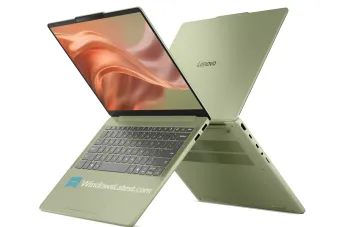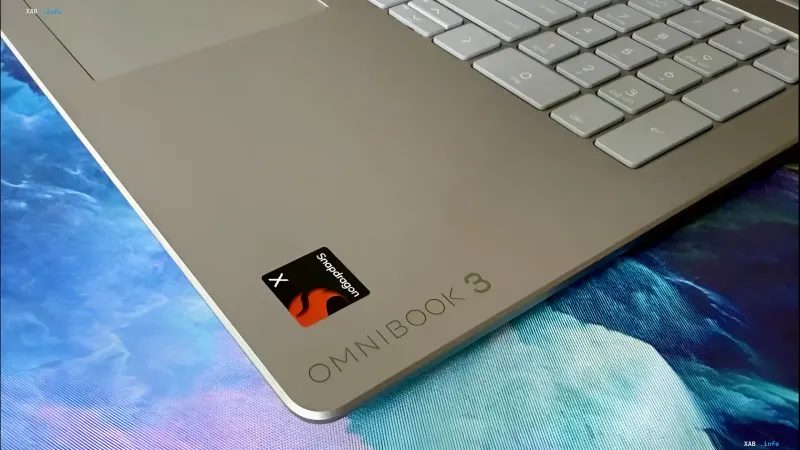
HP has decided not to cede to Apple the ground on which the Californian giant traditionally wins not on design, but on price. The company has unveiled the OmniBook 3 — an affordable 14-inch laptop that, as of the time of publication (August 2026), is already available at Best Buy for $499.99 and on Amazon for $599.99. For comparison: the competing MacBook Neo costs $699. Thus, HP immediately establishes an aggressive pricing position, betting that a budget-segment buyer will choose a Windows machine with an OLED display and a Qualcomm chip over a macOS laptop with a higher price tag.
Hardware: Snapdragon X and a bet on AI
At the heart of the OmniBook 3 lies an eight-core Qualcomm Snapdragon X processor with a clock speed of 3.0 GHz, 30 MB of cache, and integrated Adreno X1 graphics. A separate block for artificial intelligence tasks is the NPU with performance of up to 45 TOPS — this is an important marker that HP positions the device as an “AI laptop” even in the budget class. The base configuration includes 8 GB of LPDDR5X memory and a 256 GB NVMe drive. However, HP has not yet confirmed whether the memory is soldered to the board, which for many users means no future upgrade — this point is worth considering when choosing a configuration.
Display: OLED as the main trump card
The model’s main bet is on the display. The OmniBook 3 features a 14-inch OLED panel with a resolution of 1920 × 1080, 100% DCI-P3 color gamut coverage, a 0.2 ms response time, and 300 nits of brightness. The resolution is lower than that of the MacBook Neo, however, the OLED technology should deliver a more vivid picture with deep blacks and high contrast. In essence, HP is bringing into the sub-$600 segment what was previously the prerogative of more expensive machines — and it is precisely this that makes the offer stand out against the competition.
Battery life and port selection
Battery life is impressive too: a 60 Wh battery promises up to 41 hours of operation, and the package includes a 65-watt GaN adapter with fast charging support. For an inexpensive laptop, the interface selection is generous — two USB-C ports with DisplayPort 1.4 and Power Delivery support, two USB-A ports, HDMI 2.1, and a 3.5 mm audio jack. This set eliminates the need for adapters in most use scenarios.
Contradictory data
Fact-checking the sources revealed minor discrepancies in the figures. First, the stated battery life in the main description is “up to 41 hours,” whereas the headline of one of the specialized publications cites “40 hours” of operation — the difference is negligible, but formally the versions do not match. Second, the device’s price is not uniform: at Best Buy the OmniBook 3 is offered for $499.99, while on Amazon it is $599.99, meaning a $100 spread depending on the retailer. Both versions are correct within their respective sources, however, the buyer should rely on the current price of the specific store at the time of order.
Bottom line: a challenge to Apple on its home turf
The OmniBook 3 is HP’s attempt to play on Apple’s home turf, where it is usually not design but the price tag that wins. For $499.99–$599.99, the user gets an OLED display, a Snapdragon X chip with a powerful NPU, a rich port selection, and a claimed battery life of around forty hours. If HP confirms that the memory is indeed soldered, that will be a limitation, but overall the model looks like one of the most aggressive competitors to the MacBook Neo in the sub-$700 budget. It remains to be seen how the laptop will perform in real-world battery life and performance tests.