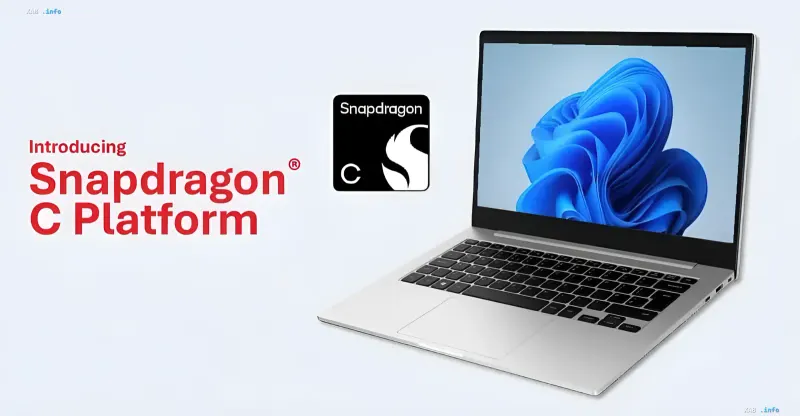
In the face of fierce competition in the mobile computing market, Qualcomm has taken a significant step aimed at capturing the ultra-budget laptop segment. As of August 15, 2026, analyzing the current situation, we can state: Qualcomm has officially introduced the Snapdragon C Platform. This solution is positioned as a driver for the most affordable laptops, capable of competing with traditional Intel and AMD processors in a price range that was previously considered a risk zone for ARM architecture.
Technical Essence and "Old" Cores
According to technical specifications confirmed by company representatives, the new system on a chip (SoC) is equipped with eight Cortex processor cores. Although Qualcomm did not disclose the exact architecture of the cores, insider information and benchmark analysis point to the use of time-tested Cortex-A78 and Cortex-A55 cores. Experts agree that Snapdragon C is, in essence, a rebranding of the SC6490 platform, which is technically very close to the Snapdragon 778G chip released back in 2021. This is a strategic move allowing the use of mature and cheap-to-produce solutions for the mass market.
Battle with Intel: Performance vs. Price
In its marketing comparison, Qualcomm chose the Intel N250 processor as its opponent. This chip, built on the Intel 7 process, technically belongs to the same time period as the Snapdragon 778G and is not a flagship solution. In benchmarks, the Intel N250 scores around 2800 points in single-threaded mode. The SC6490 platform, which underpins the new Snapdragon C, demonstrates a result of around 3000 points. In Cinebench tests, the advantage of Qualcomm's new chip is expected to reach a substantial 67%, making it extremely attractive for tasks requiring multi-threaded processing, despite the budget segment.
Contradictory Data
The pricing issue has elicited an ambiguous reaction in the industry. Initially, Qualcomm stated that laptops based on Snapdragon C would cost around $300, which was supposed to be a revolutionary moment for the market in developing countries and for students. However, according to Ixbt.com, the first models that appeared on the market turned out to be slightly more expensive than the stated amount. This creates tension: on the one hand, the chip's performance truly exceeds competitors in this class, but on the other hand, laptop manufacturers' margins do not allow them to stay within the "magic" price of $300. Thus, the promise of "super-affordability" is currently clashing with the reality of supply chains and assembly.
Market Prospects and Competition
It is important to note that the comparison is mainly conducted with a technically outdated Intel processor, which has only four cores and lacks Hyper-Threading technology. Nevertheless, the new Snapdragon C shows readiness for serious competition. By comparing it with the Intel N250, Qualcomm demonstrates that even based on 2021 architecture, one can achieve an advantage in energy efficiency and response speed. This opens the door for manufacturers such as Acer and other vendors, who previously feared implementing ARM chips in the budget segment due to software compatibility issues.