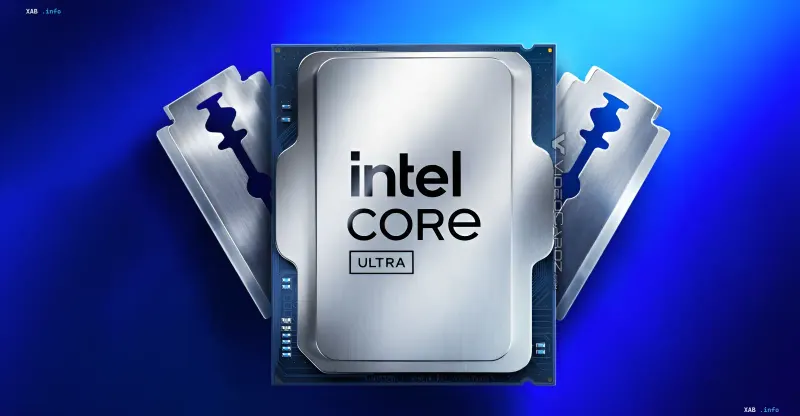
Intel has publicly acknowledged the existence of the Razor Lake processor lineup for the first time. According to the corporation's current plans, these chips are scheduled to hit the market in 2028 as the successor to the Nova Lake family. The information emerged during a speech by one of the company's executive directors, who mentioned Razor Lake-AX processors in the context of advanced computing solutions. Although details are extremely sparse at this stage, the mere fact of an official executive-level mention confirms that Intel is already actively working on the architecture succeeding Nova Lake, which is expected to debut in late 2026.
Roadmap Positioning: After Nova Lake and Bypassing Canceled AX Models
According to available data, the Nova Lake lineup will not feature processors with the AX index—meaning models with an enhanced graphics accelerator. According to insider reports, Intel originally planned to release Nova Lake-AX, but subsequently canceled them and shifted such CPUs into the upcoming Razor Lake family. However, an interesting technical detail exists: it was previously reported that Razor Lake-AX will rely on the same architectures as Nova Lake, effectively making them an architectural continuation of the current lineup despite a different commercial name. Thus, Razor Lake represents not so much a radical architectural leap as a reconfiguration and expansion of the product matrix based on already proven solutions.
Razor Lake-AX: The Answer to AMD Ryzen AI Max and a Target of 700 TOPS
Fresh leaks indicate that Razor Lake-AX processors will be Intel's direct answer to the AMD Ryzen AI Max lineup, offering an extremely powerful integrated graphics core. A milestone of 700 TOPS (trillion operations per second) is cited as the performance benchmark for AI and graphic computations. For comparison, this significantly exceeds the metrics of current mobile and desktop processors from both companies, placing Razor Lake-AX on par with high-end mid-tier discrete GPUs. If these figures are confirmed in official specifications, Intel will offer a level of computational power within a CPU lineup for the first time that was previously only available in separate graphics accelerators.
Humanoid Robots as a Target Segment
The context in which the Intel top manager mentioned Razor Lake processors deserves special attention: they were discussed in relation to solutions for humanoid robots. While this does not rule out the release of these CPUs in consumer and enterprise segments, the emphasis on robotics suggests that autonomous robotic platforms could become a priority direction for the lineup. The high computational density, energy efficiency, and powerful graphics core built into Razor Lake-AX genuinely make them an attractive choice for onboard robot computing modules that need to locally process sensor data streams and perform real-time computer vision tasks.
bLLC Cache and Competition with AMD Ryzen X3D in Laptops
Additional context regarding the Razor Lake lineup is provided by information on the possible introduction of the first mobile processors with an increased bLLC (big Last Level Cache) capacity. According to insider Jaykihn, as reported by VideoCardz, such CPUs will become direct competitors to AMD Ryzen X3D laptop processors. Meanwhile, desktop models featuring bLLC are expected to debut under Nova Lake in late 2026, whereas mobile platforms will have to wait for Razor Lake. The extra cache will reportedly be featured exclusively in HX-class mobile processors—essentially desktop chips adapted for laptops—pointing to Intel's strategic intent to capture the high-performance mobile workstation niche.
Thus, the first public mentions of Razor Lake paint a picture of a lineup designed to accomplish several strategic goals for Intel simultaneously: return powerful AX processors to the product matrix, offer a competitive answer to AMD Ryzen AI Max, claim the onboard computing niche for robotics, and strengthen positions in the mobile HX platform segment. Official technical specifications, exact release dates, and the full lineup configuration will likely become known closer to 2027, when Intel begins the active announcement phase for the post-Nova Lake generation.