American semiconductor manufacturer Micron has announced the development of a new memory class called Edge Inference Memory (EIM). According to the company's engineers, this solution is designed to help autonomous AI robots make decisions faster while consuming less power. If the technology meets expectations, its commercial launch could take place as early as 2028, bringing closer the emergence of more independent humanoid machines capable of operating in unstructured environments without predefined scenarios.
What Edge Inference Memory Is
The core idea of EIM is to combine LPDDR memory with a logic die in a single solution. This combination accelerates data processing without resorting to the high power consumption typical of multi-layer HBM memory. For robots that need to simultaneously analyze image and sound, recognize objects, evaluate their weight and texture, and then act without a predefined sequence of movements, the balance between speed and energy efficiency becomes critical. At the same time, Micron has not yet disclosed detailed technical specifications and performance figures for the new development.
Why Existing Solutions Are Falling Short
Today's AI robots typically run on models with 1–2 billion parameters, and LPDDR memory is currently sufficient for them. However, with the development of vision-language models, memory bandwidth requirements will grow, and current solutions risk becoming a bottleneck in the data processing chain. This is why Micron views EIM as a way to prepare robots for the next stage of development without forcing them to spend battery power solely on information processing.
How Much Memory Future Machines Will Need
According to Micron's own forecasts, future humanoid robots may require more than 200 GB of RAM and several terabytes of storage. For comparison, industrial service machines currently often need only 12 GB of RAM and 256 GB of storage. The gap between these figures clearly illustrates how drastically the requirements for robotic computing infrastructure will change in the coming years and why classical memory approaches will prove insufficient.
What Is Known About Timelines and Limitations
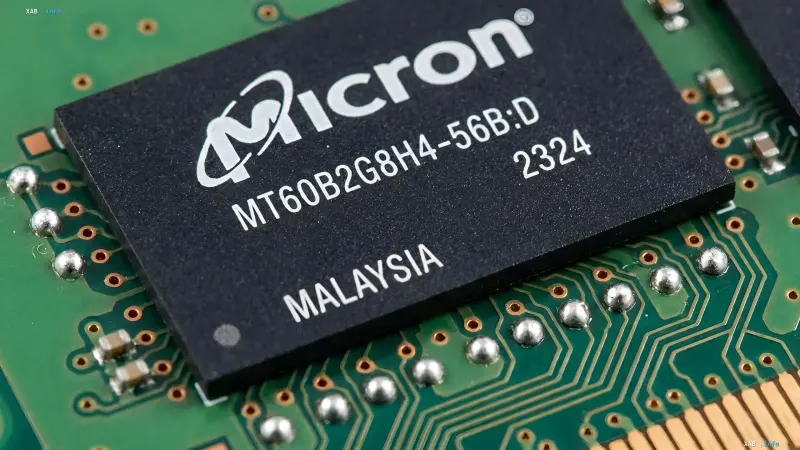
Currently, the company has not published full EIM specifications, and the commercial launch timeline — 2028 — is a forecast and depends on how successfully the technology performs in testing. Nevertheless, the very fact that a new memory class is being developed for edge AI inference confirms that semiconductor manufacturers are incorporating the mass deployment of autonomous humanoid robots into their roadmaps. The illustrative photo for the article demonstrates a typical Micron memory chip mounted on a printed circuit board.