Most upcoming NVIDIA Rubin artificial intelligence accelerators are expected to retain the complex 12-layer HBM4 memory configuration. Despite manufacturing challenges and component shortages, developers are prioritizing maximum performance for resource-intensive neural network workloads, although simpler 8-layer variants are also being discussed in the market.
Production Priorities and Rubin Memory Configuration
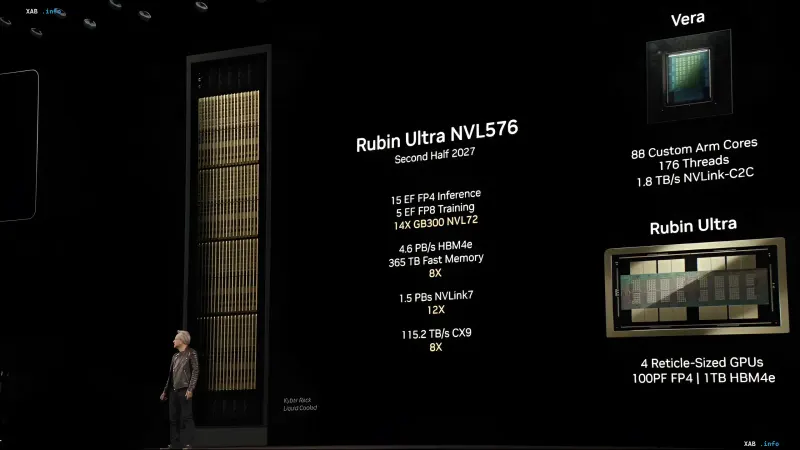
According to recent analytical reports by DIGITIMES citing Counterpoint Research, a mass transition to simplified 8-layer memory assemblies in the Rubin architecture is unlikely. Official specifications for future AI accelerators feature up to 288 GB of HBM4 memory with an impressive bandwidth of up to 22 TB/s per GPU. For large-scale computational workloads, the capacity and speed of the memory subsystem remain critically important, overshadowing potential cost savings from reducing the layer count.
Potential Supply Diversification and Samsung's Role
Concurrently, reports regarding NVIDIA's plans to increase purchases of 8-layer HBM4 modules from manufacturers such as Samsung and SK hynix are actively discussed. Such hybrid approaches can be applied selectively to overcome technological constraints, thermal management challenges, and yield optimization. Previous reports highlighted the successful completion of NVIDIA qualification tests for Samsung's memory, paving the way for large-scale shipments next year and strengthening the Korean manufacturer's position in advanced high-speed memory.
Semiconductor Economics and 2027 Price Trends
Contrary to expectations of cost reduction, TrendForce analysts project a notable increase in memory pricing. In 2027, 8-layer modules could cost 10–20% more per gigabit than 12-layer modules due to base die manufacturing economics. The overall increase in average HBM prices over the year could reach 121%, driven by supply shortages, the expansion of high-cost HBM4 versions, and the upcoming launch of the HBM4E standard in the second half of 2027.
Market Impact and AI Infrastructure Prospects
Retaining the 12-layer HBM4 structure as the primary standard for most Rubin accelerators highlights the ongoing computational power race in the artificial intelligence industry. Intensifying competition among semiconductor manufacturers, including Samsung's push for market share alongside SK hynix, will shape supply chain dynamics. Meanwhile, financial pressure on equipment makers will persist due to industry-wide silicon shortages and rising costs of advanced multi-tier architectures.