South Korean semiconductor manufacturer SK hynix has announced that the yield for its next-generation High Bandwidth Memory (HBM4) has surpassed the 70% mark. This was reported by Chosun Biz, citing sources within the semiconductor industry. The company's statement comes amid intensifying competition with Samsung Electronics and Micron Technology, both of which are also actively preparing for the mass production of next-gen memory. Experts consider a yield rate exceeding 70% at such an early stage of developing a complex technological process as one of the best in the industry and a clear signal of SK hynix's readiness for large-scale shipments.
Q3 Earnings Call: Results Exceeded Expectations
During the Q3 earnings conference held on October 28, SK hynix representatives stated that their HBM4 yield metrics at various production stages are among the best in the industry. While specific figures were not disclosed in the public report, the actual results surpassed the company’s internal projections, prompting leadership to raise their targets. As analysts note, such statements are not merely marketing tactics but an indicator that the company is confidently moving toward the mass production of memory, which will become a key component for next-generation AI accelerators.
What is HBM4 and Why Yield is Critical
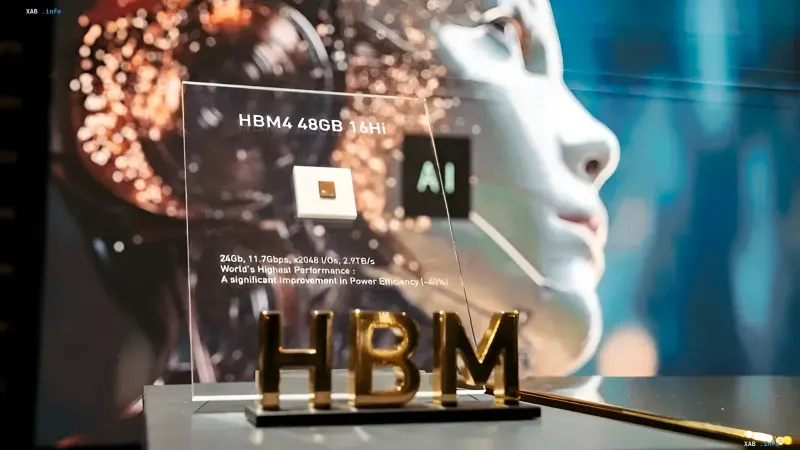
HBM4 (fourth-generation High Bandwidth Memory) is a type of RAM where multiple DRAM dies are stacked vertically, allowing for a significant increase in data processing speed and bandwidth. Compared to its predecessor, the fifth-generation HBM3E, HBM4 utilizes a 2048-bit interface, doubling the number of data transmission channels. The demonstration unit displayed at industry events features an HBM4 48GB 16Hi configuration with 24Gb per die, a speed of 11.7 Gbps, an x2048 I/O interface, and a total bandwidth of 2.9 TB/s, along with a claimed 40% reduction in power consumption.
Manufacturing HBM4 is technologically more complex than previous generations. Unlike standard DRAM, the process involves numerous stages: die fabrication, stacking, packaging, and final testing. Defects at any of these stages negate the costs of all preceding steps. Increasing the yield from 60% to 70% under similar conditions boosts the volume of functional chips by approximately 16.7%, directly impacting production costs and profit margins. There is no single stability threshold for mass-producing HBM4; actual competitiveness is assessed comprehensively based on chip performance, costs, and customer requirements.
The Competitive Race: Samsung, Micron, and the Methodology Question
Samsung Electronics and Micron are also accelerating preparations for HBM4 production. According to industry estimates from September, Samsung's HBM4 yield has reached approximately 80%. However, as experts emphasize, comparing their potential based solely on these figures is extremely difficult due to differences in calculation methodologies and measurement timeframes. According to one industry source, Samsung and SK hynix have already met customer requirements for chip performance, so the battle will shift to the speed of optimizing mass production and reducing costs. Analysts believe the initial serial production figures and supply stability will determine future market shares.
Impact on the AI Chip Market and SK hynix’s Position
Improved HBM4 production metrics directly strengthen SK hynix's position in working with AI chip developers, including Nvidia. As the computing power of AI accelerators grows, requirements for memory bandwidth and energy efficiency continue to rise. In these conditions, the supplier's ability to ensure stable supply volumes while maintaining strict quality standards becomes the decisive factor. Achieving a threshold of 70% or higher early in the HBM4 development cycle gives SK hynix additional time to refine processes and scale production, which may eventually outweigh higher but less stable metrics from competitors.