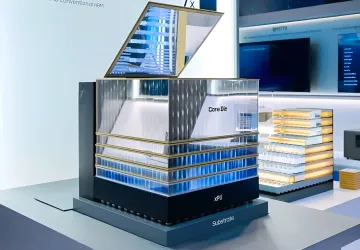
China's Huawei Technologies is developing its own High Bandwidth Memory (HBM), which theoretically could outperform products from South Korea's Samsung and SK hynix in several characteristics, according to Bloomberg. The work became known from the title of a research paper that company representatives plan to present in February at a conference in San Francisco. According to its description, Huawei engineers have created an HBM architecture with twice the contact density for data transmission compared to memory currently mass-produced by Korean makers. Increasing the number of connections theoretically allows for a significant boost in memory bandwidth and faster data exchange with processors performing resource-intensive artificial intelligence tasks.
From Theory to Microchip: How Far Along is the Development?
The key caveat emphasized by Bloomberg is that it is currently unknown how far Huawei has progressed from a theoretical architecture to creating production-ready microchips. The mere fact that the research paper's title was published confirms that the company is working on the topic, but does not indicate mass production. Nevertheless, the logic of the development fits into Huawei's already known strategy for developing its own semiconductor stack: the company previously introduced the τ (tau) scaling concept, which involves increasing chip performance by reducing signal transmission delays and optimizing interconnects rather than just shrinking transistor sizes. One of the directions of this approach has been high-density 3D vertical stacking technologies—and Huawei now appears to be transferring this exact idea to HBM memory, where increasing connection density allows more data to be transmitted between microchip layers and the processor, compensating for potentially lower operating memory frequencies with a wider bus.
Sanctions Context: Why HBM Has Become a Matter of National Importance
Producing its own HBM is of strategic importance for China, as Samsung, SK hynix, and Micron cannot supply such memory to Chinese customers due to US export restrictions. Stocks of previously purchased foreign microchips are finite, and as they run out, Chinese AI system developers will be forced to rely on local solutions. Huawei has effectively become one of the main Chinese suppliers of AI accelerators thanks to the Ascend family, which gained traction after restrictions were placed on advanced Nvidia chips. The company intends to release at least one new accelerator annually through 2029 to meet growing demand from Chinese AI developers, including DeepSeek and Moonshot. Without its own HBM, this program hits a memory bottleneck, which is why working on a high-contact-density architecture looks like a logical next step.
Technological Limitations and Workarounds
Setting up production for advanced memory will not be easy: Chinese companies are denied access to the most modern Extreme Ultraviolet (EUV) lithography systems required to produce advanced semiconductors. Therefore, Huawei has to look for alternative ways to improve performance through architecture and interconnection density rather than pure miniaturization. In parallel, China's CXMT is experimenting with the 4F2 architecture for server RAM, hoping to narrow the gap with manufacturers from South Korea and the US. Combined, these efforts point to a systemic rather than isolated attempt to close the technological gap in the AI memory segment.
Market Implications: Pressure on Korean and US Manufacturer Shares
Reports of Chinese developers' progress in advanced memory and semiconductors for artificial intelligence systems have already heightened investor anxiety: shares of Samsung, SK hynix, and Micron came under pressure amid fears that competitors from China could eventually crowd them out of the global memory market. Even the theoretical nature of Huawei's work is enough for the market to price in the risk of long-term competition, as HBM is one of the most profitable and strategically important segments of the semiconductor industry. Thus, the publication of the research paper's title in February at the San Francisco conference could be more than just an academic event—it could be a trigger for investors to reassess the competitive positions of the world's leading memory manufacturers.