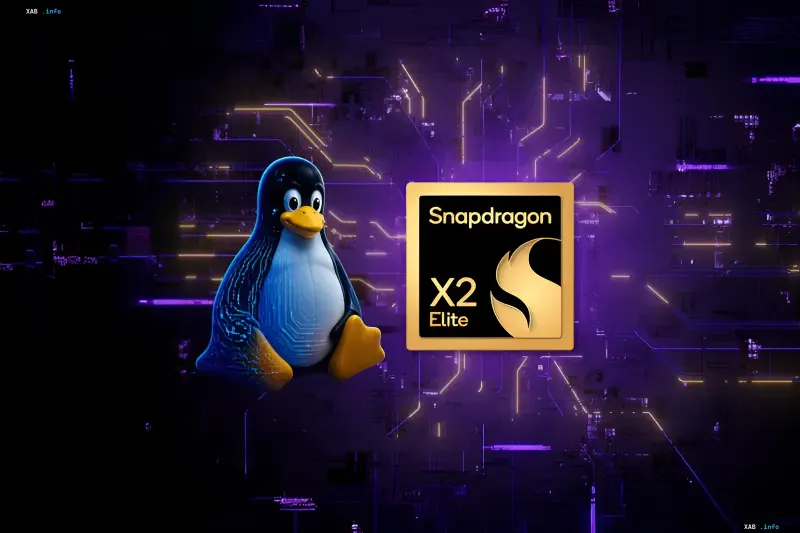
Qualcomm has officially announced ongoing efforts to ensure full and native support for the Snapdragon X2 hardware platform by modern Linux kernel-based operating systems. In the early stages of the project, the company is demonstrating platform component operations using a Debian 13 build with its own customized kernel. The primary goal of the project is to provide developers of popular distributions with robust tools for seamless chipset support.
Implementation Stages and Key Components
The rollout of Linux support on Snapdragon X2 laptops is being implemented in stages, starting with foundational components critical for device operation. Primary focus is given to mainlining drivers required for real-world tasks: open-source graphics drivers including Mesa Freedreno, Turnip, and Rusticl, as well as the Qualcomm Hexagon Neural Processing Unit (NPU) accessed via the FastRPC remote function call mechanism for direct AI acceleration.
Bootloader and System Peripherals
The systemd-boot bootloader is utilized, launching via UEFI to initialize the Linux kernel. Qualcomm has implemented basic input-output component support, including high- and low-speed peripherals, power management components, thermal controls, and overall system stability features. Developers looking to experiment can utilize Snapdragon X2 hardware and follow instructions to build and test Qualcomm Linux images.
Completion Timeline and Outlook
Qualcomm aims to wrap up the core phase of development by the end of November, while code integration into the main kernel tree will continue thereafter. The objective is to achieve software quality suitable for a broad audience, establishing a stable and fully functional foundation for commercial distributions and end products.