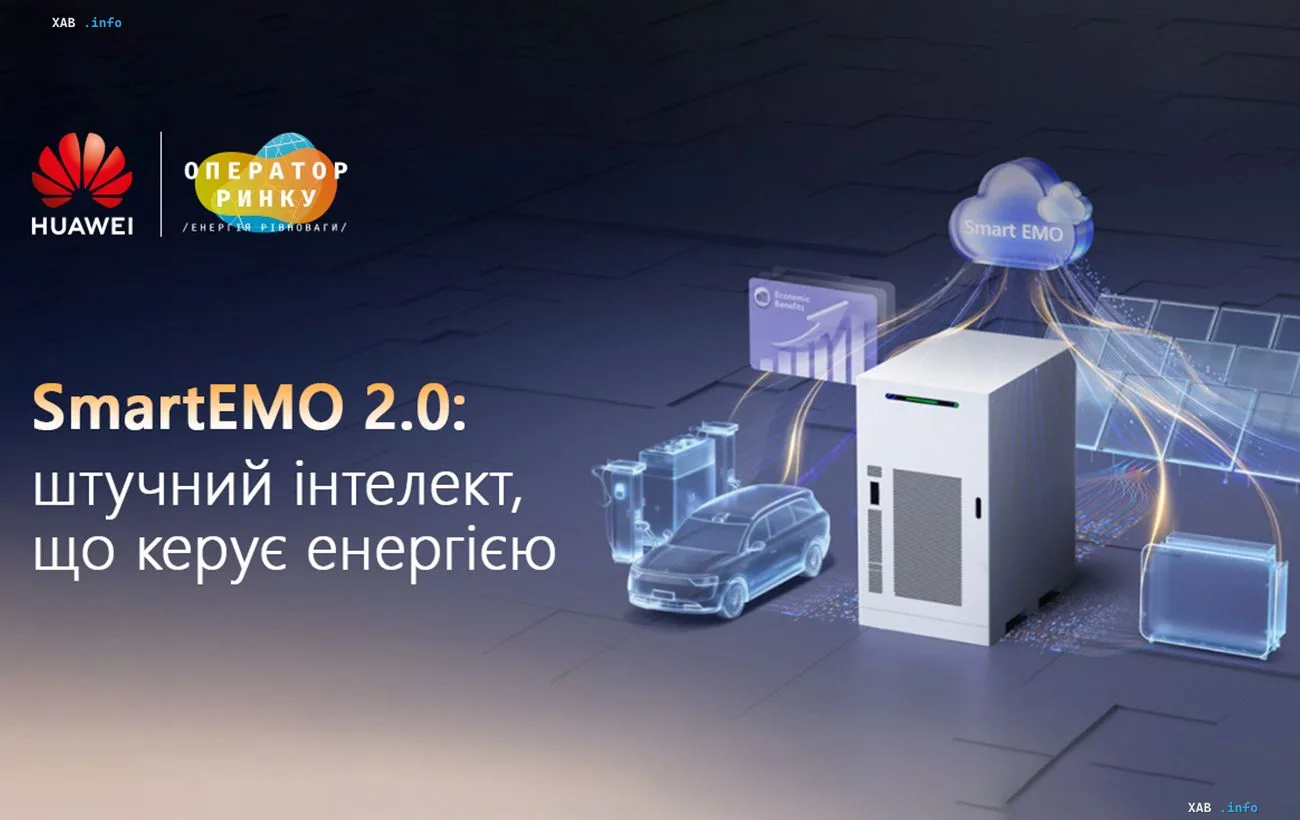
In September 2026, Huawei announced the deployment in Ukraine of the second generation of its intelligent energy storage management system, SmartEMO 2.0. Built on artificial intelligence technologies and the FusionSolar cloud platform, the solution is designed to automate the operation of energy storage systems (ESS) at industrial and commercial facilities. According to RBC-Ukraine, the system is already being actively rolled out among business consumers using the dynamic "day-ahead" tariff (DAD), which is available on the Ukrainian energy market.
Three pillars: electricity, big data, and AI
The SmartEMO 2.0 architecture rests on three interconnected components. The first is electricity itself as a limited resource, whose efficient use has become critically important for business. The second is the massive dataset accumulated by Huawei on the FusionSolar cloud platform: the company is one of the leading players in the global market of solar inverters and energy storage systems, which has given it access to a vast body of telemetry from stations around the world. The third is Huawei's own artificial intelligence developments, which turn raw data into operational decisions. It is at the intersection of these three elements that SmartEMO was born, and its second generation has been adapted to the specifics of the European and Ukrainian markets.
How the system makes decisions: from price curves to hourly plans
The SmartEMO 2.0 algorithm operates on a multi-step logic. At the first stage, the system receives the day-ahead price curve from the Market Operator. Then the specific facility is analyzed: launching the system requires at least 30 days of historical data — the consumption profile, the characteristics of any existing solar power plant, and the technical limits of the connection capacity. If a solar plant is installed at the facility, solar irradiance forecasts from the SolarGIS service are factored into the calculation. Based on all these parameters, an optimal hourly state-of-charge schedule for the storage system is generated, taking into account even the dependence of consumption on the day of the week.
However, a static forecast is only a starting point. Every 15 minutes, SmartEMO 2.0 compares actual performance against the plan, and every hour it recalculates the forecast based on fresh data. In this way, the system evolves from a one-off calculation into a self-learning control loop that adapts daily to real operating conditions. According to Huawei, the accuracy of solar generation forecasting reaches 90%, and that of the facility's load — 85%.
SOC accuracy and "gentle" battery management
A key parameter for economic efficiency is the accuracy of the state-of-charge (SOC) forecast — it determines how fully the system can exploit cheap electricity. The calculation incorporates the storage system's own parameters: battery state of health (SOH), current charge level, cell balancing, and cell temperature. According to Huawei, high SOC accuracy is ensured by the symbiosis of technologies in the LUNA2000-215/241 systems: uniform cooling of the battery cells and the inter-module charge optimizer, Optimizer 2.0. This not only maximizes the economic benefit but also extends the equipment's service life.
Economics: a 71% advantage over standard TOU mode
The practical effect of SmartEMO 2.0 is best illustrated by comparison with the standard Time-of-Use (TOU) mode, in which the storage system is charged to the maximum during cheap hours and discharged during expensive ones. SmartEMO increases the number of charge-discharge cycles per day by exploiting price fluctuations that TOU does not account for. In the example cited by RBC-Ukraine, the advantage of SmartEMO over TOU was 71.45%, and the overall electricity savings — 19.7%. For business, this means that the storage system is charged during the lowest tariff hours or from its own solar plant and discharges energy at the peak of DAD prices, turning the tariff differential into direct savings. At the same time, the system protects the facility from exceeding its connection capacity and smooths out peak loads — all of this happens automatically, without daily operator intervention.
Context: why now, and why Ukraine
The catalyst for SmartEMO's appearance in Europe was a market with dynamic tariffs and even negative day-ahead prices, which emerged due to the mass construction of solar plants. In Ukraine, negative tariffs have not yet been recorded, but DAD is already available to business consumers, making the "storage system + SmartEMO" combination a practically significant tool for reducing energy costs. In a situation where electricity remains one of the key expense items for industry and the commercial sector, AI-based automated storage management is moving from the category of "technological experiment" into that of a routine operational tool.