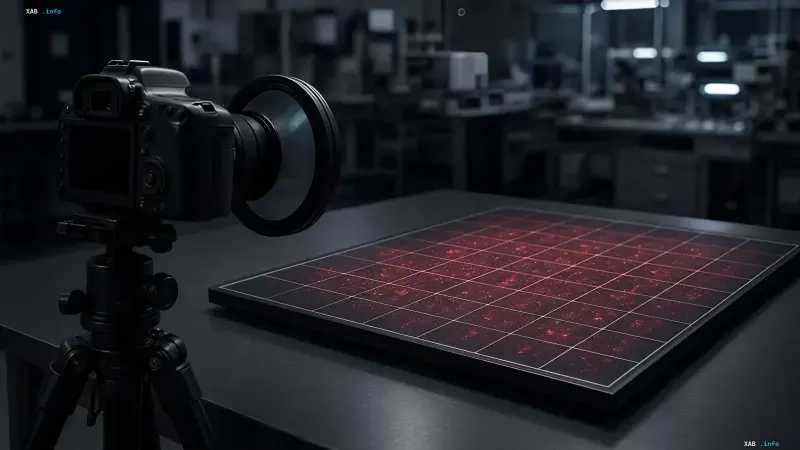
German researchers have developed an innovative technique that turns an inexpensive consumer digital camera into a powerful measuring device for the quantitative diagnostics of silicon solar cells and modules. At the core of this technological breakthrough is electroluminescence—the intrinsic emission of light from panels when connected to an electric current source. Using a modified Canon EOS 4000D SLR camera combined with a specially developed mathematical algorithm, it is possible to evaluate crucial physical characteristics of solar panels literally from a single photograph.
Technical Features of Camera Modification and Shooting
When electrical bias is applied, silicon photovoltaic cells begin to emit weak infrared radiation, the parameters of which are directly related to the quality of the semiconductor material and the open-circuit voltage. To capture this range, researchers removed the standard blocking IR filter from the camera and installed a long-wave Heliopan ES RG850 filter instead, completely cutting off the visible light spectrum. Although ideal shooting conditions require absolute darkness due to the extremely low intensity of intrinsic luminescence, the developed calibration methods successfully resolve this issue.
Mathematical Model and Measurement Calibration
The main task of the research group was not just recording infrared radiation, but accurately converting image pixel brightness into quantitative physical parameters. The camera's silicon CMOS sensor is capable of detecting radiation near 1120 nm, where silicon electroluminescence falls, and standard Bayer color filters maintain sufficient transparency. For calibration, scientists created a model accounting for both linear and nonlinear sensor operation modes, translating luminescence intensity into absolute external electroluminescent quantum efficiency EQE_LED referenced to benchmark values.
Contradictory Data
During practical testing of the method on new and old solar panels, certain discrepancies in result accuracy were identified. While calculated data for new modules demonstrated a high degree of accuracy and matched laboratory measurements, calculated figures for long-operated old panels noticeably lagged behind directly measured values. This phenomenon has not yet received an exhaustive explanation and requires further deep reflection by researchers to refine the algorithms.
Prospects for Solar Energy Express Diagnostics
The obtained results prove that electroluminescent photography can be used not only for qualitative visual defect searching but also for detailed quantitative evaluation of each section of a solar module. In the future, a calibrated budget camera will make it possible to quickly test even elements that have not previously been studied in stationary laboratories. Subsequently, German researchers intend to adapt the developed technology to perform precise quantitative measurements directly under daylight, taking renewable energy efficiency monitoring to a qualitatively new level.