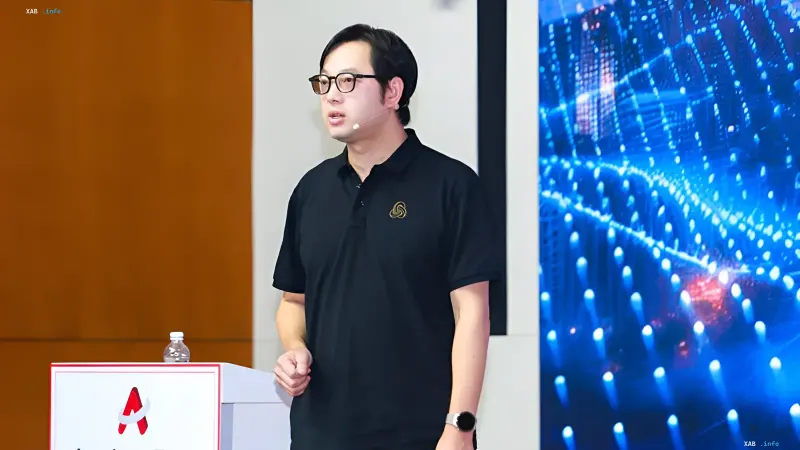
At the Decoding China 2026 industry event, Huawei presented a range of technological solutions aimed at increasing the efficiency of its mobile networks. The central element of the announcement was a technology based on the Tau scaling law, which, according to the company, ensures optimal dynamic resource planning across the entire network and reduces issues related to bandwidth limitations. Speaking at the event, Fan Xiang, Huawei Vice President and Director of the Wireless Network Business Management Committee, emphasized that the company has focused its efforts on three key areas: ensuring a universal user experience, eco-friendly and minimalist equipment design, and achieving maximum spectral efficiency.
Tau Law in Base Station Architecture
According to Fan Xiang, Huawei Wireless has applied the Tau scaling law for the first time in the design of wireless base stations. The solution, named OSCAR, provides optimal dynamic resource planning across the network. As the executive explained, under conditions where network bandwidth is limited by interference from multiple frequencies, cells, and users, traditional approaches to resource allocation are no longer sufficient. The introduction of the Tau law into base station architecture, Huawei claims, allows the system to automatically adapt resource allocation in real-time, minimizing performance losses.
High-Speed Interconnection Structure
In addition to algorithmic solutions, Huawei announced hardware innovations. The company has developed high-speed connectors and a low-latency bus that form a high-speed interconnection structure. According to Huawei, this solution ensures the real-time exchange of large volumes of data, which is critical for the operation of modern mobile networks with high connection densities. Thus, the company demonstrates a comprehensive approach: from mathematical modeling to the physical hardware layer.
Energy Efficiency and the UBPPi Series
A separate focus was placed on increasing the energy efficiency of network equipment. Huawei released a new series of UBPPi devices which, according to the company, provide a 40% energy savings compared to the previous generation. In the context of Huawei's stated course toward eco-friendly and minimalist design, this solution is positioned as an important step toward reducing the carbon footprint of telecommunications infrastructure. Base station power consumption remains one of the key expenditure items for telecom operators, so even a moderate reduction in grid load has significant economic importance.
"Two-Engine" Strategy and Global Partnership
Concluding his speech at Decoding China 2026, Fan Xiang stated that Huawei will continue to adhere to the "two-engine" innovation concept and intends to cooperate with global partners to achieve continuous breakthroughs in wireless network technologies. The "two-engine" concept, previously outlined by company management, implies the parallel development of its own research programs and open joint projects with international partners. Amid ongoing geopolitical restrictions and sanctions pressure on Chinese technology companies, the issue of access to global supply chains and joint research remains one of the key factors determining the development pace of next-generation mobile networks.