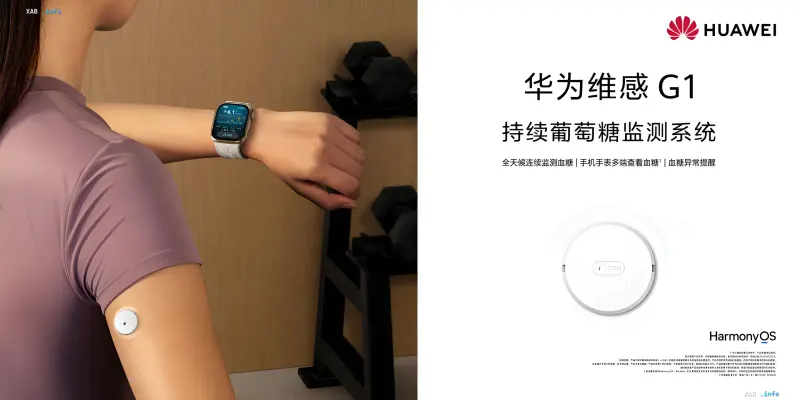
Huawei has officially announced the Visen G1, its first Continuous Glucose Monitoring (CGM) system. The device features a compact skin sensor that attaches directly to the user's body, transmitting data in real-time to Huawei smartphones and smartwatches. Measurements are displayed on the wearable device screen, and the system sends notifications if glucose levels fall outside pre-set limits. With this move, Huawei expands beyond its traditional consumer electronics portfolio into the medical wearables segment powered by HarmonyOS.
How the system works and what it measures
According to preliminary information, the Visen G1 uses a skin sensor with a soft needle, glucose oxidase, and electrodes that measure glucose concentration in the interstitial fluid. This principle is the foundation for most modern continuous glucose monitors: the sensor does not puncture a vein, but tracks sugar levels in the tissue fluid and transmits the data to a paired device. Promotional materials show the product paired with a Huawei smartwatch, which displays current glucose levels and trends, while the round sensor is applied to the upper arm.
Certification in China: Top-tier medical device
The development has passed a major official certification milestone. On October 30, the National Medical Products Administration (NMPA) of China published details regarding the registration of the Huawei system. It is classified as a Class III medical device — the highest category in the Chinese classification system, which imposes the strictest requirements for safety and efficacy. This is a significant step for the company: previously, Huawei's medical developments were largely limited to Class II certified devices and software. Moving to Class III formally opens the way for the product to be used in more clinically significant glucose monitoring scenarios.
Preliminary technical specifications
According to available preliminary data, the claimed MARD (Mean Absolute Relative Difference) accuracy is less than 10%, with a data transmission latency of 5 to 15 minutes. Reportedly, the device features a water-resistant design suitable for swimming and is designed for up to 14 days of continuous use. These parameters, if confirmed, would match the level of leading commercial CGM solutions on the market and make the product suitable for daily wear, including sports and water-based activities.
What remains unconfirmed
However, Huawei has yet to officially confirm several key details. Specifically, the aforementioned characteristics — accuracy, latency, water resistance, and service life — are currently preliminary, and the company has not yet disclosed a final list of compatible smartphones and watches. Until official confirmation and full specifications are released, some of the data should be viewed as estimates. Nevertheless, the fact that the Visen G1 has been registered as a Class III medical device and the announcement itself indicate that Huawei intends to establish a strong position in the growing continuous glucose monitoring market, leveraging its own ecosystem of wearables and the HarmonyOS platform.