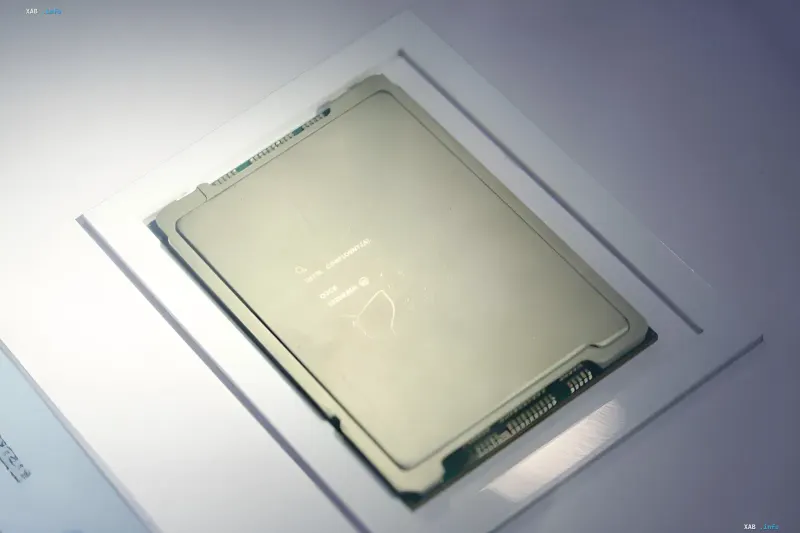
Intel has for the first time publicly demonstrated its next-generation Diamond Rapids server processor, part of the Xeon 7 family. The presentation took place at the Tencent Global Digital Ecosystem conference in China and marked the first open display of the die, which the company had previously kept under an "Intel Confidential" status. According to available reports, the market launch of the new CPU line is expected in 2027, making this information an important indicator of Intel's strategy in the data center processor segment for the next two years.
First public demonstration and presentation context
The choice of venue for the presentation was not coincidental: the Tencent Global Digital Ecosystem conference gathers key players from China's digital market and cloud infrastructure, highlighting Intel's focus on enterprise customers in the Asian region. Photos accompanying the event show a large compute die marked "Intel Confidential," indicating that technical architectural details had not been previously revealed. The demonstration confirmed that Diamond Rapids is not just a concept, but a product heading for mass production with finalized specifications.
Architecture: 256 cores without multi-threading
According to the disclosed specifications, Diamond Rapids will feature up to 256 performance cores based on the Panther Cove-X architecture. A fundamental feature of the solution is the absence of simultaneous multi-threading (SMT) support: Intel is betting on pure multi-core performance rather than doubling threads per core. The total Last-Level Cache (LLC) volume will reach 1.28 GB, a significant figure for the server segment intended to reduce latency when working with large data sets and accelerate parallel computing.
Memory, interfaces, and power consumption
The processor will support 16 memory channels and MRDIMM modules with speeds up to 12,800 MT/s, providing high throughput for latency-sensitive tasks. Interfaces include 128 PCIe 6.0 lanes and support for the CXL 3.0 standard, which opens possibilities for memory expansion and accelerators. The platform's maximum power consumption can reach 650W, requiring data centers to have appropriate cooling and power infrastructure in place.
Process nodes and Foveros Direct 3D packaging
Diamond Rapids compute dies will be manufactured using the Intel 18A-P process node, while the I/O components are slated for the Intel 3 process. The processor will feature a new layout using Foveros Direct 3D packaging, which allows for vertical integration of dies to improve density and energy efficiency. The new product is designed for the Oak Stream server platform with an LGA 9324 socket, meaning that Intel partners will need to develop compatible motherboards and cooling systems.
Competition with AMD EPYC Venice
The main competitor for Diamond Rapids will be the AMD EPYC Venice platform based on the Zen 6 architecture, which is reportedly already on the market. Both platforms will offer up to 256 cores and 16-channel memory support, making the competition in the high-end server market particularly intense. The key difference lies in the thread approach: AMD solutions support multi-threading, while Intel is opting for pure multi-core performance without SMT. This architectural choice will determine which platform delivers better results in specific corporate and cloud workloads once Diamond Rapids arrives in 2027.