Intel's Gaudi line of AI accelerators has long struggled with popularity: against the backdrop of Nvidia and AMD flagship solutions, they were perceived as a secondary alternative with significantly inferior performance. However, as it turned out, the potential of the platform's second generation — Gaudi 2, released in 2022 — was severely underestimated. The Standard Kernel development team, using artificial intelligence tools to optimize the software, managed to make this accelerator not just catch up, but in certain scenarios outperform the Nvidia H100, even though initially it lagged behind it by two to three times.
What Exactly Was Optimized and Which Model Was Tested
The work was carried out at the software level: Standard Kernel engineers used AI to redesign the kernels and computational paths to unlock the hardware potential of Gaudi 2 without replacing any hardware. The Qwen 3.5-27B model was chosen as the benchmark workload to measure performance — a large language model allowing for a fair comparison of throughput in two key inference phases: prefill and token generation (decode). It is these two phases that determine the real-world operating speed of an AI service for the end user.
The Numbers: From Lagging 2–3 Times to Leadership
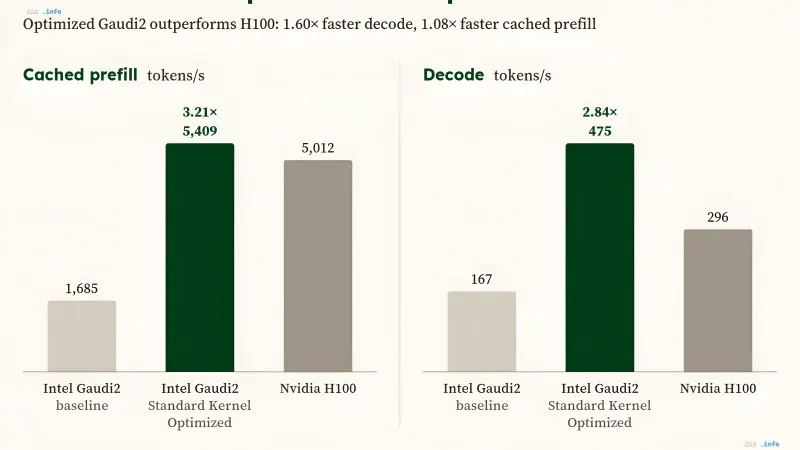
Before optimization, Gaudi 2 delivered only 167 tokens per second in decoding mode, while the Nvidia H100 achieved 296. After kernel refinement, Intel's metric rose to 475 tokens per second, which is 60% higher than the H100 result (a 1.60× multiplier). In cached prefill mode, the picture is even more striking: the baseline version of Gaudi 2 produced 1,685 tokens per second against 5,012 for the H100, while the optimized version reached 5,409 tokens per second, which is 8% faster than Nvidia's flagship (a 1.08× multiplier). Thus, in both scenarios, the gap not only narrowed — it reversed entirely.
Economics: Rental Six Times Cheaper
Gaudi 2's key advantage even before optimization lay in price: Intel's accelerators were initially cheaper than both Nvidia and AMD options. Currently, renting a Gaudi 2 costs approximately six times less than renting an H100. Given that performance is comparable or higher after optimization, the difference in efficiency per dollar becomes, in the authors' words, "monstrous." For data centers and teams deploying AI models in production, this means the opportunity to get comparable generation speed at a fraction of operational costs.
What This Means for the AI Accelerator Market
The Gaudi 2 case clearly demonstrates that an accelerator's "weakness" is often a software limitation rather than a hardware one: competent kernel optimization involving AI is capable of redistributing the performance hierarchy. For Intel, this is a potential argument in favor of the second generation of the platform; for the market, it is a signal that competition in the AI accelerator segment is increasingly shifting toward software and total cost of ownership, rather than just peak hardware specifications. At the same time, it is important to note that these results were obtained on a specific model and configuration, and transferring them to other scenarios requires separate verification.