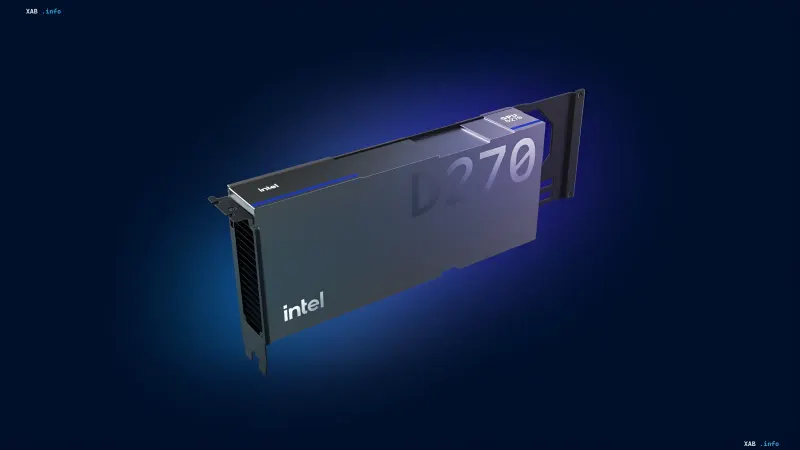
Intel has released comparative data showing that its recently unveiled D270 AI accelerator not only competes with the flagship Nvidia RTX Pro 6000 Blackwell but, in several computing scenarios, outperforms it by several times. At first glance, the gap seems paradoxical: the D270 is built on a relatively modest GPU with 32 cores of the Xe3P architecture, whereas the Nvidia card is positioned as a top-tier professional accelerator. The key to understanding Intel's claims lies in the specific tasks chosen for the demonstration and the architectural features of double-precision number processing.
D270 Architecture and Key Specifications
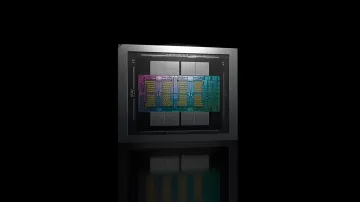
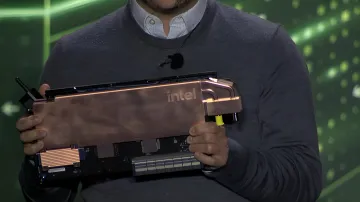
The Intel D270 accelerator, previously known by the codename Crescent Island, is primarily oriented toward AI computing rather than gaming or professional 3D graphics. Consequently, Intel has dropped support for traditional 3D rendering and ray tracing, allocating die area for computational operations. The device is based on the Xe3P architecture and delivers up to 1.3 PFLOPS of compute performance in FP8 format, featuring 32 cores, 256 XMX blocks, 32 MB of unified L2 cache, and a memory bandwidth of 1.5 TB/s. In terms of memory capacity, the D270 significantly outperforms its rival: 160 GB of LPDDR5X versus 96 GB of GDDR7 in the RTX Pro 6000 Blackwell, and Intel's partners will be able to expand this capacity up to 480 GB. The device's nominal power is 350W with passive air cooling, characteristic of standard server racks, which is nearly half the 600W power draw of the Nvidia solution. According to Intel, a single D-series accelerator can handle AI models with up to 300 billion parameters.
Financial Benchmarks: Where Intel Sees Its Main Advantage
As a clear example, Intel highlighted financial sector tasks where the D270 shows the most impressive gap. In the Black-Scholes (American) test, the Intel accelerator proved to be nearly twice as fast as the Nvidia flagship. In the Black-Scholes (European) variant, the lead increased to 5.6x, and in the European Monte Carlo, to nearly 6x. These specific scenarios formed the basis for claims of the D270's multi-fold superiority over the RTX Pro 6000 Blackwell while using nearly half the energy.
Why the Gap is So Large: The Role of FP64 Computing
Such a massive gap with such different GPU levels is explained by Intel's choice of tasks where FP64 (double-precision) computation is critical. The Xe3P architecture supports native FP64 operations with 64 fused multiply-add operations per Xe core, making the D270 especially effective in such scenarios. The RTX Pro 6000 Blackwell, in contrast, was designed primarily for professional graphics and AI-driven calculations; thus, the comparison is essentially taking place on a field where the Nvidia card is not specifically optimized. This is an important caveat: the D270's massive lead is not a universal performance metric for all classes of tasks, but rather reflects the specifics of the selected benchmarks.
Comparison in AI Tasks
Intel also compared the accelerators in AI-related scenarios. In tests on the Qwen3-30B-A3B model in FP8 format, the D270 accelerator showed 12% (1.12x) higher throughput than the RTX Pro 6000 Blackwell. In Drex 2.0 tests, the company reported a 29% reduction in latency. These results indicate that even in Nvidia's "home turf" of AI scenarios, the D270 is capable of competing with the flagship, albeit without the massive multi-fold lead seen in financial benchmarks.
Context and Conclusions
It is important to view the D270's positioning within Intel's strategy to enter the data center and AI computing market. The accelerator does not claim to be a universal competitor to top-tier Nvidia and AMD solutions in gaming or professional graphics; its focus is on power efficiency, high memory capacity, and robust double-precision computing. For financial and scientific tasks requiring FP64 precision and bandwidth with moderate consumption, the D270 could be an attractive alternative. That said, the final assessment of performance in real-world workloads will depend on the specific task, and Intel's claimed multi-fold advantages should be viewed as the result of carefully selected benchmarks rather than an absolute indicator of superiority across all scenarios.