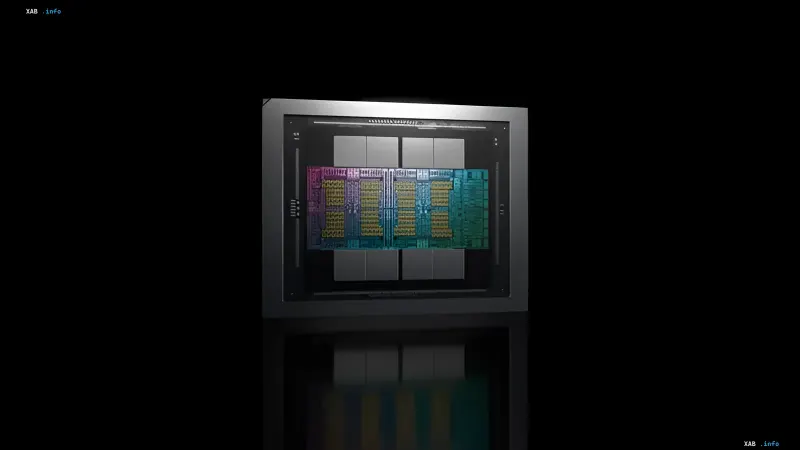
Nvidia has announced the Rubin HPC graphics processor, designed for high-performance scientific and engineering computing, as well as large-scale data analysis. According to the manufacturer, the accelerator will feature over 50,000 CUDA cores — a figure nearly 2.5 times higher than the compute core count of the GeForce RTX 5090 gaming graphics card. This effectively confirms that Nvidia's next flagship architecture will be divided into two distinct lines: consumer and professional, with the professional variant receiving a significantly more robust computing base.
Positioning: Science and Engineering, Not AI Training
Rubin HPC will be part of the Vera Rubin platform, yet its primary purpose is geared toward complex computational tasks rather than training and running artificial intelligence models. Among the priority application areas, Nvidia highlights climate and engineering simulation, genomic analysis, and financial risk assessment. This means the chip is optimized for tasks where precision and bandwidth are critical when working with large volumes of structured and unstructured data, rather than mass neural network inference.
Cores and Architecture: Over 50,000 CUDA
The key quantitative parameter announced was the number of compute cores: over 50,000 CUDA. For comparison, the gaming GeForce RTX 5090 has less than half as many such cores, putting the Rubin HPC outside the consumer segment and orienting it toward server and cluster configurations. Nvidia has not yet disclosed the exact core count, memory capacity, or memory bandwidth, nor has it released power consumption figures or performance in FP32 and FP64 modes — the very metrics traditionally vital for double-precision scientific calculations.
Sparse Data Acceleration
One of the stated key features of the GPU is its sparse data acceleration technology. According to the manufacturer, this ensures more efficient data transmission to the compute cores, reducing idle time spent waiting for information. For scientific tasks involving large datasets and repetitive, identical calculations, this directly impacts overall system performance by mitigating bottlenecks during the data delivery stage to the cores.
Connectivity and Software Ecosystem: NVLink 7 and CUDA-X
For data exchange between graphics processors, support for the seventh generation of NVLink is provided — a high-speed, point-to-point serial interconnect technology. This is essential for building multi-processor nodes, where the speed of inter-core and inter-card communication determines computational scalability. Additionally, Rubin HPC will support Nvidia CUDA-X libraries, containing optimized algorithms for scientific computing and analytics. In particular, AI agents will be able to utilize them to perform simulations and test various hypotheses, linking the new accelerator to the growing field of autonomous computational agents.
What Is Still Unknown and When to Expect It
Despite the high-profile announcement, Nvidia has not disclosed a number of practical characteristics: the exact CUDA core count, memory capacity and bandwidth, power consumption, FP32/FP64 performance, or the cost of the accelerator and the system configurations based on it. Names of manufacturing partners for Rubin HPC have not been revealed either. The graphics processor is expected to become available in 2028, leaving the industry time to refine the platform and finalize the product's technical profile.