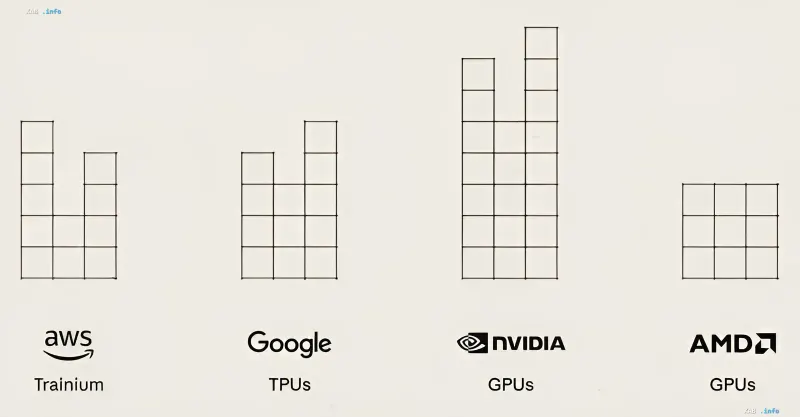
Anthropic has announced that it has shed its dependence on Nvidia hardware by building its strategy around the use of multiple chip types simultaneously. The company's key claim is that it managed to port its own artificial intelligence model Claude to AMD graphics processors in just three days — and with virtually no human intervention. According to Anthropic co-founder and head of compute Tom Brown, the company now trains and runs Claude on hardware from four major chip suppliers: AWS Trainium, Google TPU, Nvidia GPU, and AMD GPU. Thus, the company views compute resources with different architectures and in different geographical locations as a single interchangeable pool.
Three days instead of months
The most serious test for Anthropic was working with AMD graphics processors. Previously, adapting a new chip platform required the efforts of dozens of engineers over many months. This year, the company utilized AMD GPUs for the first time and entrusted the task to its own advanced AI model, Mythos. According to Anthropic, the Claude model started running on AMD chips in just three days with almost no human intervention: the model independently ported or wrote nearly 100 percent of the necessary software kernels.
An unconventional bet on four platforms
According to Brown, early on Anthropic made an "unconventional bet" on using different chip types, while most industry participants considered such an effort unjustified. Each chip type requires its own specialized software and stack for computation and inference, which is costly and time-consuming. Nevertheless, the company has invested in this direction for years and, in Brown's assessment, has achieved "incredible success" in it.
Breaking the CUDA barrier
Nvidia's main competitive advantage lies in the combination of hardware and software, specifically the CUDA ecosystem, which "locks" developers into the company's chips. Historically, porting AI models to other chip architectures required so much effort that many companies didn't even try. If Anthropic's results are independently verified, this could mean that the software barriers long considered Nvidia's main trump card will be significantly reduced thanks to artificial intelligence itself. Companies will be able to switch between suppliers more easily, choosing the most cost-effective or available options. Amid equipment shortages and Nvidia's margins exceeding 70 percent in the AI chip market, this flexibility becomes a strategic asset: Anthropic claims it gets more return on every dollar invested in compute than any other advanced AI lab.
Compute multipliers and recursive self-improvement
In addition to its multi-platform strategy, Anthropic relies on so-called "compute multipliers" — scientific breakthroughs that deliver higher performance with the same physical compute power. According to the company, these multipliers complement each other: each new breakthrough reinforces the effect of the previous one. In the future, the Claude model should learn to find such multipliers independently, which would mean a transition to recursive self-improvement — a concept actively discussed among AI researchers but not yet practically proven.
Anthropic Direct and competitor investments
Under the "Anthropic Direct" program, the company is building its own data center capacities: instead of simply renting cloud resources, it takes chips into use and operates them in specially prepared data centers, reducing total cost of ownership. Notably, both competing chipmakers — Nvidia and AMD — are actively investing in Anthropic itself. Nvidia promised to invest up to $10 billion in the company in late 2025 and is participating in a $26 billion private placement round ahead of an IPO, according to SEC filings dated November 10, 2026.