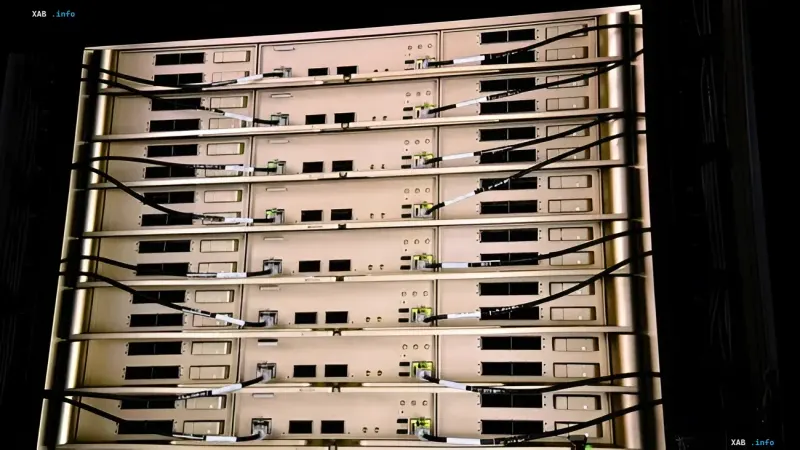
Elon Musk's companies SpaceX and xAI have begun developing a custom version of the Nvidia Vera Rubin NVL72 computing system under the codename Kessel. The project retains the basic configuration of Nvidia's flagship platform: 72 Rubin graphics processors, 36 Vera processors, and nine NVLink switch blocks. However, the key difference lies in abandoning traditional cable connections, which, as the current-generation server rack image shows, take up significant space and create maintenance complexities. Instead, the company intends to use a massive 84-layer printed circuit board that integrates computing modules and switches into a single unit.
Passive Board Architecture: Compute Blocks on Opposite Sides
The Kessel design involves placing computing blocks and switches on opposite sides of a passive board. This approach minimizes signal trace lengths and reduces data transmission losses between components. The main technological feature of the board is the use of ultra-low-loss M10 copper-clad materials. By comparison, the Nvidia Kyber architecture underlying the current NVL72 platform uses a 156-layer board with M9-class materials. Halving the layer count theoretically simplifies the manufacturing process and improves production yields during the mass-production phase.
Manufacturing Challenges: Why 84 Layers Is Not a "Simplified" Task
Despite the formal reduction in layer count compared to the 156-layer Kyber board, manufacturing an 84-layer PCB remains an extremely complex and costly undertaking. Modern server motherboards typically feature 15 to 20 layers, making an 84-layer design vastly more difficult to produce. Even minor defects in the internal layers can result in the rejection of the entire structure, requiring high-precision inspection at every assembly stage. This means initial yields could be significantly lower than those of mature 15–20-layer boards, and unit production costs considerably higher.
Procurement Strategy: Direct Nvidia Contracts and Third-Party Suppliers
Another fundamental difference between Kessel and standard Nvidia solutions lies in the component procurement approach. SpaceX intends to purchase accelerators, processors, switches, and network components directly from Nvidia, while the remaining system elements—including the circuit boards themselves and chassis solutions—will be ordered from third-party suppliers. This model allows the company to independently choose board manufacturers and assembly partners, tailoring the hardware to its own infrastructure. Notably, the materials emphasize that the Kessel architecture accounts for future orbital computing deployments, where mass, power consumption, and fault tolerance requirements differ significantly from ground-based data centers.
Context: Why Musk Needs a Proprietary Platform
The development of Kessel fits into Elon Musk's broader strategy of creating a vertically integrated computing infrastructure. Combining the resources of SpaceX and xAI bridges competencies in aerospace systems and artificial intelligence. Transitioning from cable connections to a single passive board reduces failure points, simplifies logistics, and potentially lowers the total cost of ownership during scaling. At the same time, dependence on Nvidia remains critical: the American chipmaker supplies the system core—Rubin accelerators and Vera processors—without which the platform cannot function. Thus, Kessel is not a replacement for Nvidia, but an adaptation tailored to the specific demands of Musk's two companies, including prospective orbital computing nodes.