An unusual listing has appeared on the Chinese second-hand marketplace Goofish: a seller is offering a modified Nvidia GeForce RTX 5090 graphics card with 96GB of GDDR7 memory—three times the standard capacity of the flagship accelerator. It is specified that the card is sold as part of a complete computer system, and the transaction is purportedly available only to corporate clients. The price stated in the ad is nominal: interested buyers are encouraged to contact the seller directly and sign a non-disclosure agreement. According to several publications, similar modified accelerators have also been offered on Alibaba for around $3,888, which is significantly lower than the retail price of a standard RTX 5090 in the US.
What Is Visible in the PCB Photo
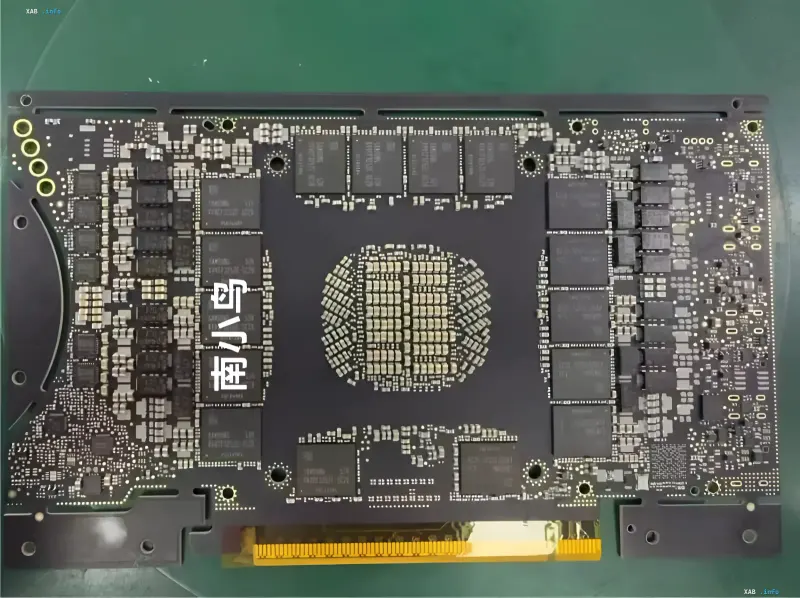
The published image of the front and back of the printed circuit board allows for the identification of the GB202-300-A1 graphics processor—the same chip used in the standard retail GeForce RTX 5090. Around it are Samsung GDDR7 memory chips: the photo reveals 16 chips marked K4VCF325ZC-SC28 with a capacity of 3GB each, totaling 48GB. To reach the claimed 96GB, 16 more of these chips would logically need to be installed on the back of the board, which is not shown in the photograph. Thus, the stated volume is confirmed only indirectly through the visible part of the memory and the logic of the layout.
Expert Assessment: Board from a Professional Accelerator
Renowned Russian graphics card repair specialist Viktor Veklich (known as VIK-on) assesses such a modification as technically feasible. He suggests that the modification is based on a printed circuit board from the professional Nvidia RTX PRO 6000 Blackwell Max-Q accelerator, which natively supports 96GB of GDDR7. The expert identifies the primary difficulty of the adaptation not as the manufacturing or soldering of the board, but as the configuration of a modified VBIOS firmware, which must correctly recognize the non-standard memory set and ensure stable operation.
Chip Markings and GPU 'Transplant' Practice
The photograph reveals the markings of the graphics processor with a production date of the 32nd week of 2025. This may indicate that the chip was extracted from a standard retail RTX 5090 and moved to another board. This practice is not new: there have been previous reports of Chinese workshops stripping GPUs and memory from Nvidia gaming cards and installing them onto different PCBs, creating custom configurations.
Context: The AI Boom and a Series of Backyard Mods
The emergence of the 96GB version fits into a broader trend: the Chinese market has already seen modifications of GeForce RTX 5080 with 32GB, RTX 4090 with 48GB, and RTX 3090 with 48GB of memory. Growing interest in such modifications is linked to the artificial intelligence boom: the increased video memory capacity allows available accelerators to be used for AI workloads, where bandwidth and memory capacity are often more important than raw computational power. Rumors have also circulated about the creation of an RTX 5090 version with 128GB of memory, although the 96GB configuration looks more plausible from a technical standpoint. Notably, Nvidia does not officially confirm the existence of such modifications, and all technical details are based on seller data and enthusiast evaluations.