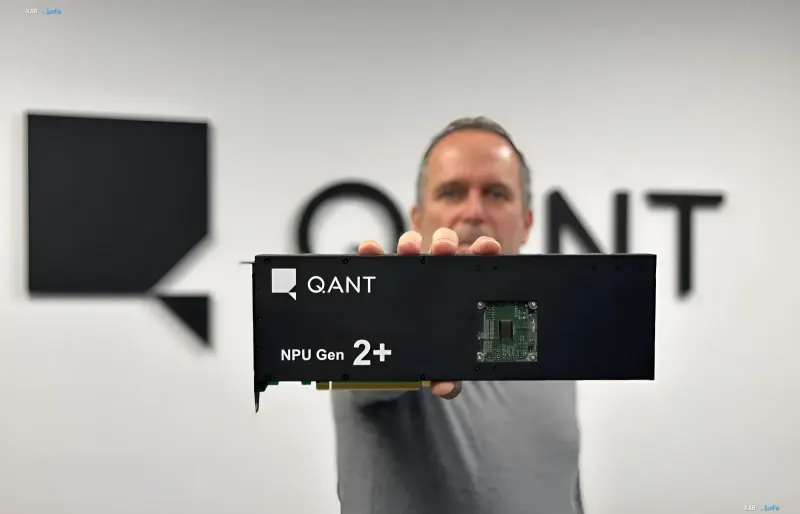
German company Q.ANT showcased its NPU Gen 2+ photonic processor at the SC26 exhibition—a device where a Large Language Model (LLM) utilizes an optical Fourier transform. The key feature of the system is that the Fourier transform is performed directly via light, rather than by traditional electronic computations. According to the developers, this is the first application of an optical Fourier transform within a running Large Language Model. At their booth, the company demonstrated the photonic processor working in conjunction with an AMD graphics processor.
Optics Instead of Electronics
The Fourier transform is a fundamental mathematical operation widely used in signal processing and in various neural network architecture computational blocks. In classical systems, it is implemented by electronic circuits, whereas in the NPU Gen 2+, Q.ANT shifts this operation to the optical domain: the signal is transformed by light. The company cites this approach as the main differentiator of its solution and claims it is the first instance of using an optical Fourier transform inside an active Large Language Model.
Integration with AMD GPU
It is important to note that the photonic processor was not presented as a standalone replacement for a computing platform. At SC26, Q.ANT showed its operation paired with an AMD graphics processor, i.e., in a hybrid configuration where the optical unit performs its part of the tasks in combination with an electronic GPU. Such an approach is typical for early demonstrations of new computing architectures: compatibility and functionality of components are confirmed first, and scaling is discussed only later.
What Is Confirmed and What Is Not
The company's initial announcement contains no comparative performance or power consumption metrics for the NPU Gen 2+ relative to traditional electronic systems. The demonstration confirms that the claimed approach works in principle and that the photonic processor is capable of interacting with an LLM and an external GPU. However, this does not prove the solution's superiority in terms of speed, accuracy, or energy efficiency. Until independent benchmarks and detailed technical specifications are available, any conclusions regarding the device's practical competitiveness remain premature.
Context: The Bet on Photonic Computing
The introduction of the NPU Gen 2+ at SC26—one of the world's largest high-performance computing exhibitions—indicates that photonic computing is gradually moving from the laboratory phase to the stage of public demonstrations of ready-made modules. For the industry, this is a signal that alternative physical principles of computation, including optical ones, are beginning to be considered as potential elements of future AI platforms. Nevertheless, mass adoption of photonic units in commercial systems is still far off, according to the demonstration itself: at the current stage, the key result is the confirmation of the approach's viability, not its quantitative superiority.