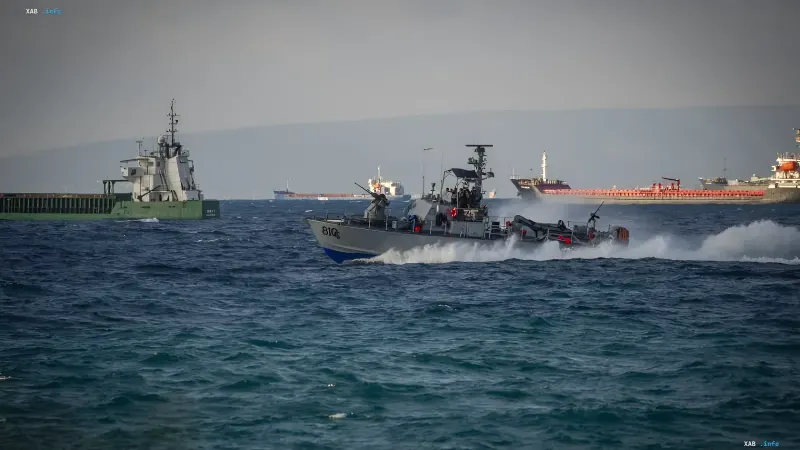
On August 16, 2026, it was announced that a large-scale modernization of Israel's coastal defense had been completed. According to the Jerusalem Post, the new system, dubbed the «Iron Wall», was formed in response to critical gaps in protection identified during the investigation of the October 7, 2023 attack. The incident, in which Hamas militants managed to reach the coast on speedboats, forced Tel Aviv to radically rethink its strategy for countering maritime threats.
Lessons of October 7: The Interception Failure
The key catalyst for change was the attack by the «Nukhba» (elite units) of Hamas. During the assault, terrorists used seven speedboats to advance toward the Israeli shore under heavy rocket and mortar fire. Despite the active actions of the Israeli Navy, which intercepted five of the seven vessels, two boats managed to break through to the shore. These vessels landed 18 militants, which came as a shock to the Israeli security system and demonstrated the vulnerability of the coastal zone.
Architecture of the New Defense and the Role of Admirals
Following the incident, the Israeli Navy, in coordination with Shin Bet (General Security Service) and military intelligence, initiated a deep reorganization. The process began under the command of the Navy Vice Admiral David Salame, who implemented a series of operational changes. His successor, Admiral Eyal Harale, accelerated this process, formulating a new doctrine: effective defense must be capable of continuous learning and real-time adaptation. The result was a multi-layered protection system covering sea, air, and land, with the ability to exchange surveillance data between all forces in real time.
Technological Superiority: Shaldag Mark V and UAVs
One of the main components of the «Iron Wall» was the deployment of high-speed patrol boats Shaldag Mark V. These vessels possess significantly greater range and autonomy compared to their predecessors. They are equipped with upgraded surveillance systems and enhanced firepower. In combination with unmanned aerial vehicles (UAVs) and ground-based surveillance systems, the boats form a unified network, allowing multiple forces to track a single target simultaneously, eliminating the possibility of a stealthy breakthrough.
Mobilized Reserve and «Zero Tolerance» Policy
To create echeloned defense along the coast, a mobile unit on all-terrain vehicles was deployed. This force serves as a reserve line of defense, ready for immediate response in case the enemy breaches the interception perimeter in the coastal zone. The Israeli Navy also adopted a strict «zero tolerance» policy to gradually eliminate the maritime combat capabilities of Hamas and PIJ. According to officers, Hamas motorboats have practically disappeared from the Gaza shores, but the threat remains in the form of the group's use of low-tech means, such as rowing boats.