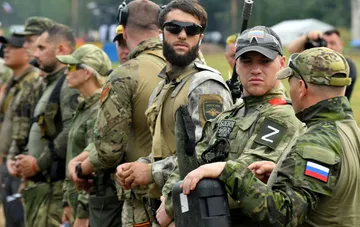
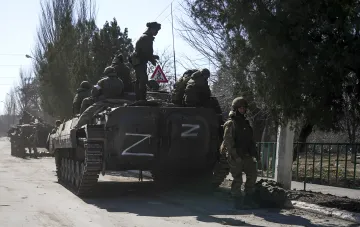
Russian officials and military bloggers have once again started talking about an alleged massive encirclement of Ukrainian Armed Forces units northeast of Kharkiv. According to their version, the Russian army has surrounded Ukrainian units between the directions toward Volchansk and Burshtyn (Bolshe-Burlyuk), with military bloggers going even further, claiming that a "large number" of Ukrainian soldiers are under threat. However, as follows from a fresh report by the Institute for the Study of War (ISW), analysts found no evidence of such an encirclement.
What Russian Officials and Military Bloggers Claim
Russian official channels and military bloggers' Telegram channels are consistently pushing the narrative of a "kettle" (encirclement) on the Kharkiv axis. It is reported that Russian forces have allegedly closed the ring around Ukrainian units in the area of Volchansk and Burshtyn. According to ISW, some Russian war correspondents cite a specific figure — allegedly around 2,000 Ukrainian soldiers were encircled near Volchansk — while, as the institute notes, even some Russian war correspondents do not believe these estimates. Thus, within the Russian information environment itself, the encirclement version is already being questioned.
ISW's Assessment: No Evidence of Encirclement
Analysts at the Institute for the Study of War state directly that no publicly available confirmation of the encirclement of Ukrainian units in this area exists. Based on available data, ISW continues to assess that Russian forces have not encircled any Ukrainian troops on this section of the front. The institute thus separates propagandistic claims from the actual situation along the line of contact and finds no grounds for concluding that a tactical or operational "kettle" has formed northeast of Kharkiv.
Contradictory Data
There is a direct discrepancy between the versions here. On the one hand, Russian officials and military bloggers insist on a massive encirclement of Ukrainian forces between Volchansk and Burshtyn. On the other hand, ISW states that there is no evidence of such an encirclement and that no encirclement has occurred. An additional contradiction emerges on other sections: earlier, Russian war correspondents themselves acknowledged that the Russian army was forced to retreat from certain positions near Lyman, explaining this as the consequence of the spread of false reports to the command — because of them, units were not receiving fire support at positions that, in the reports, were already counted as captured. A similar mismatch is observed around Sviatohorsk in Donetsk Oblast: the Kremlin claimed it had been captured, while the city is fully controlled by Ukrainian military.
Context: "Pretty Reports" and Their Price
ISW links such discrepancies to a systemic problem in Russian military reporting. According to the institute's assessment, so-called "pretty reports" for the leadership lead to operational errors and additional losses among the ranks. When positions are recorded as captured in reports before they are actually secured, the command stops allocating fire support and reinforcements, which ultimately results in retreats and unnecessary losses. Thus, the narrative of an "encirclement near Kharkiv" fits into a broader picture in which Moscow's information claims regularly outpace and are not confirmed by the actual situation on the front.
Bottom line: the statement by Russian officials and military bloggers about a massive encirclement of Ukrainian forces northeast of Kharkiv is, at this point, not supported by evidence that independent analysts could verify. ISW continues to consider that the encirclement of Ukrainian units on this section has not occurred, and the discrepancies between Moscow's reports and the actual picture of the front remain one of the key indicators of problems in the Russian command system.