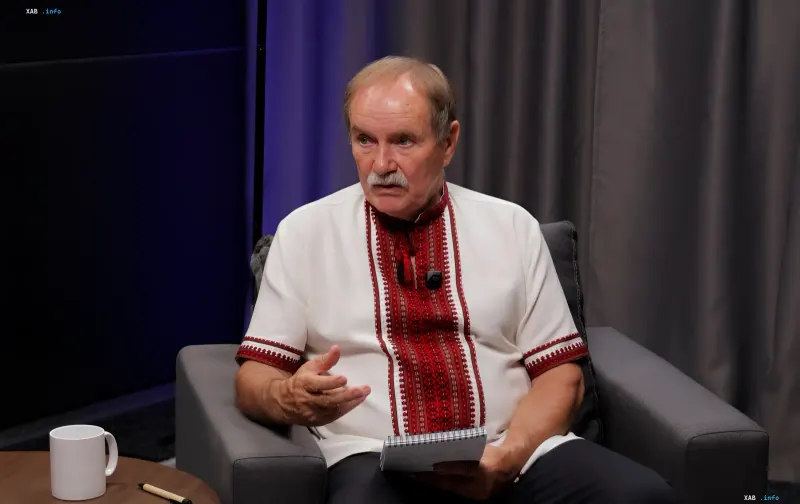
August 1991 became a turning point in the history of Ukrainian statehood. During those days, while the GKChP coup was unfolding in Moscow, the fate of the future state was being decided in the Verkhovna Rada of the Ukrainian SSR. One of the founders of Independence, a People's Deputy of five convocations and co-author of the Act of Independence of Ukraine, Ivan Zayets, told RBC-Ukraine in an exclusive interview about the behind-the-scenes battles, strategic maneuvers, and historical decisions that led to the proclamation of independence on August 24, 1991.
The Historical Window of Opportunity
Ivan Zayets recalls that on August 24, 1991, he thought least of all about the communists. For him and his parliamentary colleagues, a "window of historical opportunity" opened, which could not be missed. The appearance of the GKChP in Moscow threw all the cards of the Soviet system into confusion, forcing the communist majority to act under threat and without a real choice. This made the task easier for Ukrainian democrats, who immediately seized the initiative, declaring the coup an unconstitutional overthrow.
The opposition, represented by the "People's Movement of Ukraine" and the "People's Council," did not let go of this initiative until August 24 — both in the parliamentary hall and on the streets, where a multi-thousand manifestation with blue-and-yellow flags stood against the walls of the Rada. Zayets emphasizes that at that moment, the communists simply had no other choice, as they had discredited themselves by participating in and supporting the GKChP.
Behind-the-Scenes Battles and Political Cunning
In the interview, Zayets reveals details of the behind-the-scenes battles in the Verkhovna Rada hall, where the fate of the future state was decided every day and every hour. He recalls the flexible tactics of the "sailor-politician" Leonid Kravchuk and the strategic cunning of Ivan Pluch, who masterfully conducted the session on August 24. Kravchuk, as a statesman, understood that it was necessary to act quickly and decisively so as not to miss the historical moment.
Zayets also tells about legendary jokes that saved the situation in critical minutes. For example, the famous phrase "Deputy Zayets, do not jump around the hall" became a symbol of how, in the tense atmosphere of the parliament, moments of humor were found that helped maintain calm and concentration.
Contradictory Data
In the interview, Zayets notes the difference between the communists of the first parliament (1990) and the second (1994). In 1990, among them there were orthodox believers, but there were also many pragmatists who felt where the new winds were blowing. They had already voted for the abolition of Article 6 of the Constitution on the monopoly of the CPSU and for the Law on the economic independence of the Ukrainian SSR. But those who came in 1994 were already populists who, as they say, "sliced sausage on the hoods" of the first parliament.
However, some historians and political scientists believe that even in the first parliament there were enough orthodox believers who could have sabotaged the independence process if not for external pressure from the GKChP and mass protests in the streets of Kyiv. This creates a certain uncertainty in assessing the role of communists in the process of proclaiming independence.
The Role of Russia and Imperial Ambitions
Zayets emphasizes that among the communists there was no deep understanding of the process. They perceived Russia through the prism of the figure of Yeltsin. For them, the Soviet Union seemed to be a real union of peoples, although in fact it was the same Russian Empire — just Soviet and communist. And it did not matter who its head was — whether Gorbachev or Yeltsin. They were both imperialists! The difference lay exclusively in the methods.
Gorbachev thought that he would slightly "tweak" the USSR, give it, as he said, a "human face," rewrite the union treaty — and the people would believe. And the Russian authorities led by Yeltsin understood that this resource was exhausted, so they decided to pull the powers from the union bodies to the Russian ones, in order to later start "gathering lands" again, as Russia had done repeatedly in history.
Conclusion
On the 35th anniversary of Ukraine's Independence, RBC-Ukraine is launching a special project "Ukraine: 35 Years of Independence" — a series of interviews with people who directly participated in the building of Ukrainian statehood. The first guest of the cycle was Ivan Zayets, whose memories and analysis of the events of August 1991 help better understand how Ukraine's independence was born and what forces stood behind this historical decision.