Jeans have long ceased to be just a practical item in one's wardrobe and have evolved into a key element of any outfit. However, as stylist Yana Markovskaya notes in her Instagram video, not every trendy style works equally well for different body types. "If you still think that jeans cannot visually add 5 kilograms out of nowhere, I have bad news for you," the specialist stated. According to her, the problem lies not so much in the model name as in how the specific cut interacts with body proportions: height, leg length, hip width, and waist rise. The same style that looks perfect on one woman might ruin the silhouette of another.
Flared jeans: when the trend works against you
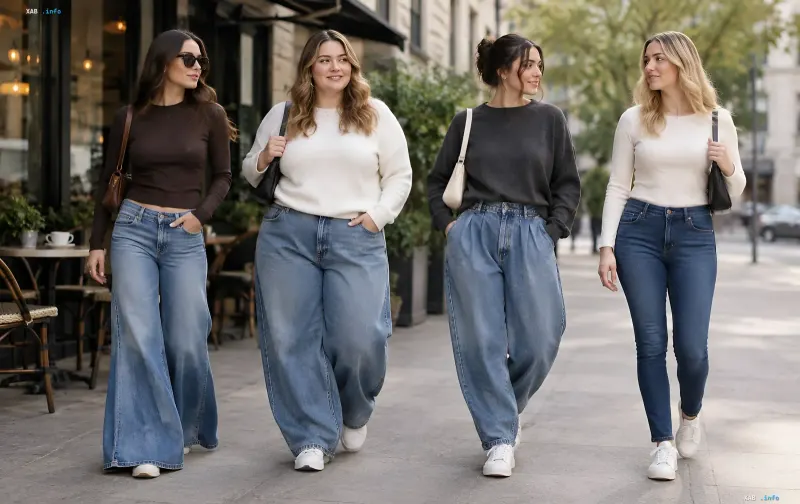
The first model the stylist advises paying attention to is knee-flare jeans. Their hallmark is a tight fit in the hip area with a sharp flare below the knee. This cut can visually widen the hips and shorten the legs, especially if the model features a low-rise fit. "Hips widen, legs appear more massive, and you look shorter," explains Markovskaya. According to her observations, this style works most poorly on short women and those who strive to visually lengthen their lower body. At the same time, the stylist emphasizes that flares are not inherently "forbidden"—it is important to consider the combination with the rise and the overall length of the trousers.
Barrel leg: volume that isn't for everyone
O-silhouette or barrel leg jeans remain one of the most prominent trends of recent seasons. Their main feature is additional volume on the sides, creating a rounded, barrel-like shape. Due to this cut, legs may appear wider and the overall silhouette less elongated. Markovskaya recommends that short women and those who do not want to emphasize leg volume approach this model with caution. The trend does not override the rules: if a style does not work for your proportions, it won't become a good choice just because influencers are wearing it.
"Banana" and slouchy jeans: loose cuts with nuances
The third group of models includes "banana" and slouchy jeans. They are characterized by a loose cut, rounding out the hip line and forming extra fabric folds. On some figures, this silhouette looks like an effortless oversized style; on others, it emphasizes leg features one might prefer not to highlight. The stylist points out that when choosing such jeans, it is important to evaluate not only the fit at the waist but also the overall line of the trousers from the hip to the ankle. Folds and excess fabric at the bottom can visually "eat" leg length.
Skinny jeans: an accent where you don't want it
The fourth model Markovskaya advises being careful with is skinny jeans. Due to their tight fit, they clearly define the line of the legs and hips, making these zones the main accent of the outfit. If you don't want your hips and calves to attract maximum attention, the stylist recommends looking for looser models. At the same time, skinny jeans are not "bad"—they simply require a conscious choice: on some figures, this tight cut looks most harmonious.
Rise and footwear: two tricks that save the look
The stylist separately highlights the role of the rise. Instead of a low waist, Markovskaya advises choosing a mid or high rise—they help maintain visually harmonious proportions and do not shorten the legs. "A low rise ruthlessly steals leg length. Therefore, despite all trends, it is better to avoid it," emphasizes the expert. The second trick that can make even complex styles more successful is pointed-toe footwear. This shape creates an additional vertical line in the lower part of the outfit and visually extends the leg line. Furthermore, you don't need heels to achieve this effect: pointed-toe ballet flats, loafers, or flat shoes also work to lengthen the silhouette. This trick is especially useful in combination with flare, banana, and barrel leg models if you want to balance their voluminous cut.
Trends do not override proportions
The main conclusion Yana Markovskaya draws is that fashion trends should not be the only guide when building a wardrobe. It is important to evaluate how a specific model works with your specific proportions, whether it is comfortable to move in, and whether you like the result in the mirror. Even trendy jeans do not need to be bought just because fashion bloggers have them. A correctly selected rise, length, and shape of trousers, according to the stylist, are far more important than the name of the style. Jeans are a tool, not a dogma: the wardrobe's task is to highlight the strong points of the figure, not to fight against it.