The Chinese brand JETOUR, which is actively expanding its presence on the market, offers a lineup of crossovers primarily focused on family usage scenarios. The philosophy of these models is based on spacious five- or seven-seat interiors, thoughtful ergonomics, and a set of technological solutions that handle routine household tasks. According to RBK-Ukraine, it is the combination of spaciousness, material quality, and flexible storage functions that makes JETOUR crossovers competitive in the family transport segment.
Seven-Seat Layout and Interior Ergonomics
The flagship capacity models in the lineup—the JETOUR X70PLUS and JETOUR X90PLUS—offer three rows of seats in a 2+3+2 layout, allowing up to seven passengers to be accommodated simultaneously. Meanwhile, the five-seat JETOUR T1 focuses on second-row spaciousness and legroom for long trips. The front seats in all models available feature a well-designed profile with side support; the driver's power seat operates in multiple directions, and several versions feature four-way lumbar power adjustment. The second row accommodates three adult passengers and allows the installation of one to three child seats. For families where the vehicle is used by multiple drivers, a seat position memory function is implemented.
Interior Materials and Storage System
JETOUR interiors utilize soft-touch plastics, metal-look decorative elements, and leather- and suede-trimmed details; the seats typically feature combined upholstery. The storage architecture deserves special attention: the JETOUR T1 i-DM hybrid crossover features 45 practical compartments for small items, while the JETOUR T2 offers over 50 niches. The rear seatbacks fold down to form a flat floor in the cargo area, simplifying the loading of large items and allowing cargo to be distributed rationally.
V2L Function: The Car as a Mobile Power Plant
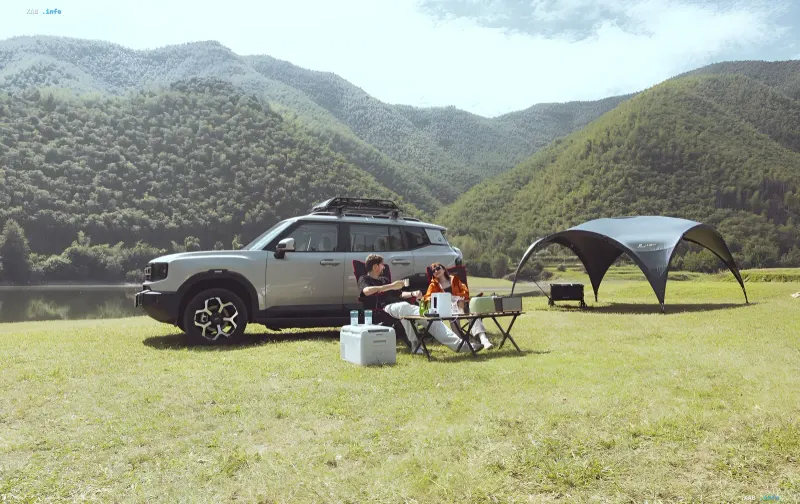
One of the most practical solutions for local conditions is the Vehicle-to-Load (V2L) function implemented in the plug-in hybrid JETOUR T1 i-DM. A high-voltage socket located in the cargo compartment allows external electrical appliances to be powered from the vehicle's traction battery. Using a special adapter, the crossover can deliver up to 3.3 kW of power—enough to run a refrigerator, a laptop, charge an electric scooter, or power camping equipment. In conditions of periodic power outages, this feature turns the car into a fully functional backup power source for a home or campsite.
Air Quality Control and Hybrid Powertrains
For passenger comfort in urban traffic and long journeys, JETOUR equips its models with an Air Quality System (AQS). An onboard sensor continuously assesses the external environment and sends a signal to the climate control unit: upon detecting pollution, the damper automatically switches the system to recirculation, and after normalization, returns the fresh air supply. The driver does not need to manually switch modes when entering a tunnel or an area with heavy exhaust. Automatic AQS is available in the JETOUR T1 i-DM, and an intelligent air purification system is implemented in the JETOUR DASHING. The hybrid powertrains of the JETOUR lineup, in turn, provide a balance between traction, efficiency, and smoothness, which is especially valuable on long family routes.
Context: JETOUR in the Region and Test Drives
Interest in JETOUR crossovers extends beyond the local market: in October 2026, a test drive of the seven-seat Jetour X70 Plus was held in Kazakhstan, where the 'Auto-Region' publication noted the evolution of the model's design, three screens in the cabin, and the use of expensive trim materials. The X70 family, according to the testers, has gone through several generations of restyling, and the current version represents a mature product with refined ergonomics. For the buyer, this confirms that the models offered locally meet the brand's current standards and are not simplified variants.