Journalists from RBC-Ukraine conducted a detailed comparative test of three crossovers from the Chinese brand JETOUR — the X50, X70PLUS and T1 i-DM — to determine which one is best suited for city driving, family use and long-distance travel. All three models share a common concept: a unibody structure, modern design and a focus on practicality. However, each car has its own design philosophy. The T1 i-DM looks like a classic SUV with straight lines, flat surfaces and bulky body cladding, while the X50 and X70PLUS feature more complex body panel shapes and smooth transitions. It is clear that the cars were created for different target audiences — from young drivers looking for a compact city crossover to families with children who need space and a third row of seats.
Dimensions and Exterior Design
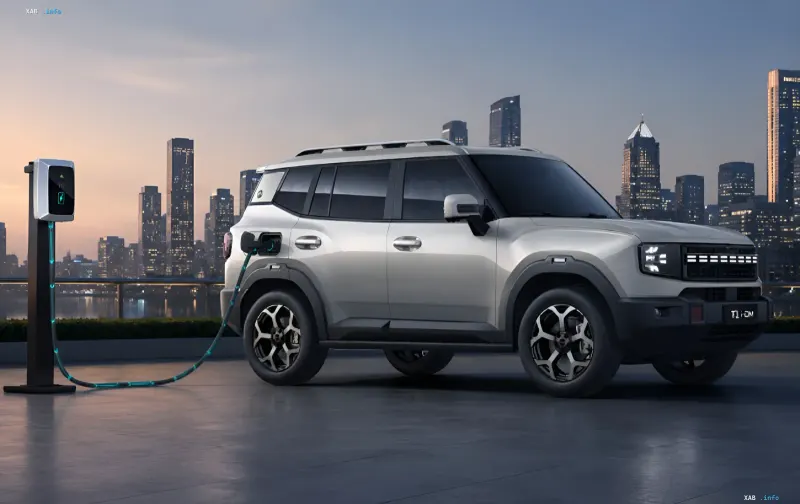
In terms of size, the JETOUR X50 is the most modest of the trio: its length is 4,397 mm, width — 1,841 mm, height — 1,654 mm, and wheelbase — 2,601 mm. The Jetour X70PLUS is noticeably larger: 4,724 mm in length, 1,900 mm in width and a 2,720 mm wheelbase. The T1 i-DM model takes an intermediate position in length (4,705 mm) but stands out with the maximum width (1,967 mm) and height (1,843 mm) on a 2,800 mm wheelbase. The rectangular shapes, large headlights, bulky radiator grille and wide body panel cladding make the T1 i-DM look even bigger than it actually is. At the same time, all three crossovers have a ground clearance of around 200 mm and large wheels, allowing them to handle sections without quality asphalt. The metal roof rails can be fitted with mounts for bicycles, skis or an additional luggage carrier — a useful option for long trips.
Interior and Cabin Equipment
The X50 interior is dominated by a restrained color palette and pleasant-to-the-touch materials. For visual variety, the designers actively used contrasting trim strips, as well as a relief pattern on the upper part of the dashboard and doors, created by laser engraving. The seats feature perforation and decorative stitching. In cold weather, the driver and passengers have access to heating for the front and rear seats, the steering wheel, the washer nozzles, and the windshield and rear window. In front of the driver is a pair of 10.25-inch touchscreens: a digital instrument cluster with several display layouts (Ukrainian language is available) and an infotainment system with a simple, readable interface. The second row is relatively spacious: there are climate control vents on the center tunnel, a rear center armrest with cup holders and a pair of USB ports. Up front, in addition to USB, there is a powerful 50-watt wireless inductive charging pad with cooling. The X50 trunk is rated at 398 liters; a temporary spare wheel is located under the floor. With the second-row seatbacks folded, the volume increases to 1,262 liters, and the space becomes flat.
Space and the Third Row: X70PLUS and T1 i-DM
The X70PLUS offers a more textured interior: the design combines leather, aluminum and pleasant-to-the-touch lacquered plastic. The instrument panel features a horizontal screen that, under a single piece of glass, combines two 10.25-inch displays. The main feature of the cabin is the third row of seats. Adult passengers will find it comfortable for short trips, while children can travel comfortably over long distances. In the five-seat configuration, the X70PLUS trunk holds 438 liters. In the taller T1 i-DM, passive footrests help with seating. The instrument panel is a 10.25-inch screen, and a large 15.6-inch media system tablet is mounted in the center of the dashboard. The crossover has two rows of seats, and the temporary spare wheel is located in the underfloor of the trunk. The T1 i-DM trunk is the most spacious of the three models: 574 liters behind the second-row seats and 1,262 liters with the seats folded.
Engines and Transmission
All three crossovers are equipped with petrol engines. The JETOUR X50 is available with one of two engines. The base Luxury trim is equipped with a 1.5-liter naturally aspirated engine producing 113 hp (138 Nm) paired with a five-speed manual transmission. The Premium version is powered by a turbocharged engine of the same displacement producing 147 hp (210 Nm) with a six-speed dual-clutch robotic transmission. Drive is front-wheel only in either case. Notably, both engines consume 7.3 liters per 100 km in the combined cycle. Under the hood of the X70PLUS is a 1.6-liter turbocharged petrol engine producing 190 hp. The T1 i-DM model, judging by its designation and the presence of a charging port (as confirmed by the visual material), is a plug-in hybrid (PHEV), combining a petrol engine with electric drive and the ability to charge from an external power source.
Contradictory Data
The review text states that "the heroes of our review are equipped with petrol engines," which may create the impression that all three models are exclusively combustion vehicles. However, the "i-DM" index in the name of the T1 i-DM, as well as the visual material showing the car connected to a charging station, clearly indicate that this model is a plug-in hybrid (PHEV). Thus, the wording about "petrol engines" is correct only in the sense that the hybrid powertrain includes a petrol engine, but it does not reflect the full picture of the energy system. In addition, the sources do not provide exact figures for the power and torque of the T1 i-DM's petrol engine, nor the parameters of its electric component, which limits the completeness of the comparison of dynamic characteristics.
Conclusion: Which Crossover to Choose
Choosing among the three JETOUR models is largely determined by the use scenario. For the city and everyday trips with one or two passengers, the X50 looks optimal in terms of the ratio of dimensions, cost and economy — it is compact, easy to handle and affordable in the base trim. For families with children who value a third row of seats and extra volume for children's belongings, it makes more sense to look at the X70PLUS with its 438-liter trunk in the five-seat configuration and a richer interior. For those who value an off-road look, maximum seating height and the largest trunk (574 liters), and who are ready to consider a hybrid powertrain to reduce fuel consumption in the city, the T1 i-DM will be the most versatile solution. All three crossovers offer a ground clearance of around 200 mm and roof rails, making them suitable not only for asphalt but also for light off-road and travel with additional luggage.