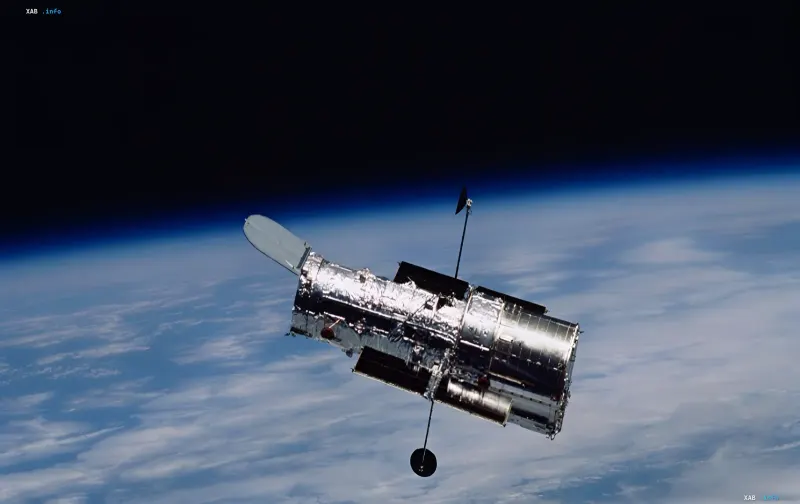
Astronomers using the James Webb Space Telescope (JWST) have detected a powerful infrared signal in a region of space where no radiation source had previously been detected. The mysterious object was recorded during a re-investigation of the famous Hubble Deep Field—one of the most detailed images of the early universe taken by the Hubble Space Telescope. The study's findings have been published in the peer-reviewed journal The Astrophysical Journal and are already generating widespread interest in the scientific community, as the nature of the source remains entirely undetermined.
Observation Method: Searching in "Blind" Mode
Researchers from the University of Minnesota applied an unconventional approach using the NIRSpec spectrograph aboard JWST. Instead of deliberately targeting the instrument at already known galaxies, the scientists opened virtually all of the spectrograph's micro-shutters, closing only those onto which bright foreground objects were projected. This "blind" mode allowed them to identify faint and distant sources that might have been lost in traditional observation methods. Astronomers conducted two observation sessions 88 days apart—in August and November 2023. Both times, the instrument recorded six already known distant galaxies, but the seventh detection puzzled researchers: a clear and bright emission line at a wavelength of 1.6 micrometers appeared, belonging to no known object.
Signal from Absolute Emptiness
The main feature of the discovery is that none of the previous images by Hubble or JWST recorded any galaxy or star at this point—essentially, absolute emptiness. At the same time, the signal appeared in all four sets of images obtained at verified angles, completely ruling out the possibility of a digital distortion or imaging artifact. Scientists emphasize that if the object had existed stably, its brightness should have been noticeable even during preliminary deep-field surveys. This indicates that the radiation source either appeared suddenly or experienced a short but exceptionally powerful flash.
Four Hypotheses—None Fit Completely
The study's authors considered four main hypotheses for the flash's origin. First, an early galaxy: however, a bright line at a wavelength of 1.6 micrometers should have been blocked by the neutral hydrogen of the early universe, which is not observed. Second, a nearby galaxy: such an object would have been required to create additional accompanying emission lines, none of which were found. Third, a supernova: an explosion of this type should also have left other characteristic spectral traces. Fourth, tidal disruption of a star by a black hole: such a mechanism can create a single line, but available data are insufficient to confirm this version. According to the authors, the object is in "extremely extreme physical conditions" that do not fit any standard models.
Prospects for Further Research
To determine the exact nature of the mysterious source and its redshift, astronomers plan to conduct a series of deeper spectroscopic observations using NIRSpec and other JWST instruments. Successful identification of the object could revise existing views on physical processes occurring in the early universe and open up a new class of astrophysical phenomena. Meanwhile, the signal from "absolute emptiness" remains one of the most intriguing unsolved mysteries of modern astronomy.