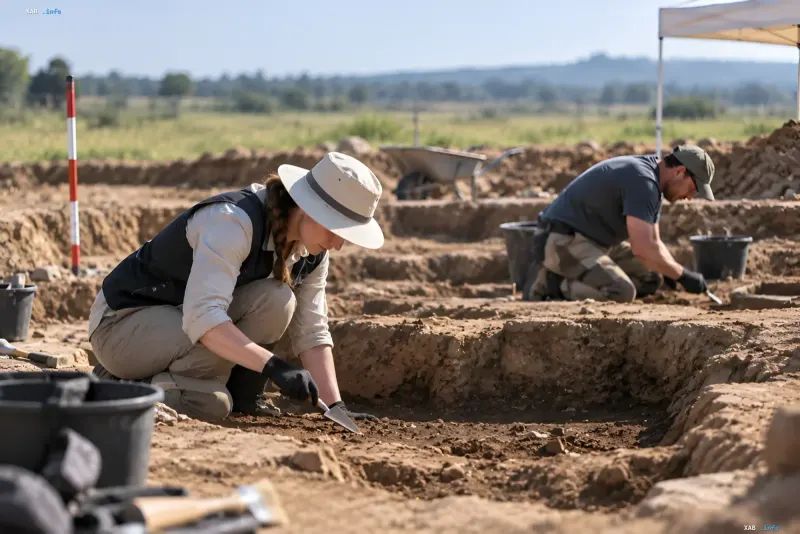
In the village of Grosskoelnbach (Dingolfing-Landau district, Lower Bavaria), during a five-week excavation at the Steigaecker IV site, archaeologists discovered a human skeleton approximately 7,000 years old, positioned in an unusual, contorted posture. The find, made during the survey of an ancient settlement, has sparked keen interest among researchers: the adolescent skeleton was found in a pose inconsistent with the standard burial practices of the Linear Pottery culture, and deformations in the cervical spine have added to the mystery. The remains were removed from the burial site and transferred to the district archaeological agency for detailed anthropological analysis.
A pose inconsistent with ritual
Archaeologist Dr. Florian Eibl, responsible for the site, explained that members of the Linear Pottery culture—one of the oldest farming cultures in Central Europe—traditionally buried the deceased lying on their side with bent legs, the so-called "sleep pose." However, the skeleton from Grosskoelnbach differed significantly: the right leg was sharply bent, while the left was directed outward, giving the body an overall asymmetric, contorted appearance. The shape of the grave pit, which had a steeply sloping bottom rather than a flat one, may partially explain the anomaly: researchers suggest the body may have shifted after being placed in the pit, and individual bones may have pressed into the soft clay. Nevertheless, the question of whether the unusual pose is the result of a deliberate ritual or natural displacement of the skeleton over millennia remains open.
An adolescent from the early farming era
Preliminary anthropological data indicate that the deceased was an adolescent: the bone growth zones had not fully fused, indicating incomplete biological development. Specialists paid particular attention to the cervical spine, where noticeable deformations were recorded. At this stage, it has not been determined whether these are caused by pathology, congenital features, or mechanical impact during or after burial. A definitive answer, according to experts, can only be provided by detailed laboratory analysis, which is currently underway at the district archaeological agency.
150 findings and three longhouses
The skeleton was just one of many findings at the site. Over five weeks of work, the research team documented about 150 archaeological remains belonging to the Linear Pottery culture, dating back to the 6th millennium BC. Among them are traces of three longhouses, although it is unlikely that all three structures existed simultaneously. Remains of hearths and kitchen areas were relatively well preserved: some hearths were built of clay in the form of vaults, and the floors were insulated with tightly packed pebbles. These constructions provide insight into the lifestyle and cooking methods of early farming communities.
Quern stones as a marker of trade relations
Of particular interest to researchers were the discovered quern stones. The materials used for their manufacture may have come from the region across the Danube or from the Bavarian Forest. If this assumption is confirmed, the find will serve as additional evidence that early inhabitants of the region traveled and exchanged materials over significant distances, broadening our understanding of the scope of contacts during the era of agricultural expansion in Central Europe.
What's next
The excavation site is currently closed to the public. The remains have been handed over to specialists for comprehensive anthropological research, which should shed light on the adolescent's health, the causes of the spinal deformations, and the nature of the burial ritual. As archaeologists note, not all questions can be answered after seven millennia, but every detail—from the shape of the pit to the mineralogical composition of the quern stones—brings researchers closer to a fuller understanding of life and death in one of the oldest farming settlements in Central Europe.