In central Anatolia (Turkey), archaeologists have reported the discovery of a group of unique obsidian arrowheads decorated with engraved geometric patterns, dating back some nine thousand years. The research results were published in the professional scientific journal PLOS One; the find is reported by RBC-Ukraine. Although the artifacts themselves are well preserved and their age has been established, scientists still cannot explain the purpose of the symbols applied to them: no unified sign system has been detected, and none of the designs repeats another.
“Black gold” of the prehistoric era
Obsidian — a dark volcanic glass with a mirror-like sheen — was prized in the prehistoric era as “black gold,” primarily thanks to the extraordinary sharpness of its cutting edge. The territory of central Anatolia hosted rich deposits of this rock, which is why archaeologists in this region regularly unearth thousands of ancient tools and weapons. At the same time, only a tiny fraction of the obsidian artifacts found bear unusual engraved marks, making each such find exceptional.
New finds at Tepeçik-Chiftlik
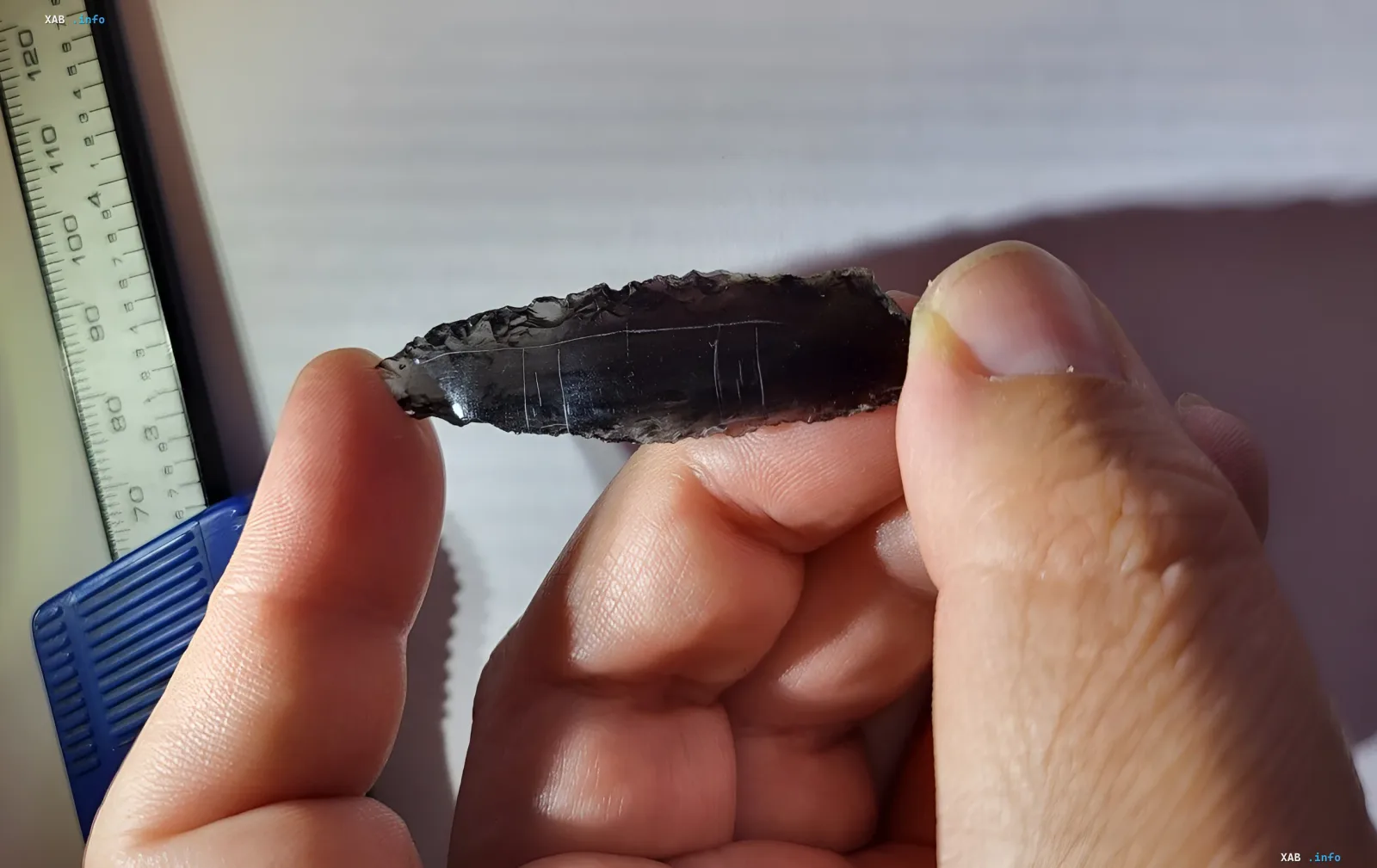
The new article in PLOS One describes 11 newly discovered engraved arrowheads found during excavations at the Neolithic settlement of Tepeçik-Chiftlik. Including these artifacts, the total number of known engraved arrowheads from central Anatolia has risen to 54 specimens. In the photograph attached to the publication, a characteristic glossy black-surfaced obsidian arrowhead with fine parallel notches applied by hand is visible; a ruler is placed nearby for scale.
Domestic context and traces of use
Importantly, despite their rarity, such items are not found in cemeteries or ritual complexes, but in ordinary houses and stone-working workshops — alongside simple everyday tools. Microscopic analysis of wear indicates that the weapons were actively used in daily life: for hunting or in military conflicts. In other words, the engraved arrowheads were not ceremonial but working objects, which complicates any attempt to explain the patterns purely as a symbolic or cultic function.
Engraving technique and the absence of a unified system
Carving a pattern into obsidian is an extremely labor-intensive task: the material is hard and brittle, so the craftsmen had to use even harder tools, such as flint. On one of the arrowheads, researchers recorded that the same line was deepened up to 20 times to make the notch visible. Despite the high precision of execution, there is no unified system in the placement and nature of the signs: the patterns are arranged asymmetrically — both in the center and at the edges — and the lines were carved both on fully finished products and at intermediate stages of processing. None of the 54 known designs repeats another or matches images on other Neolithic monuments.
Contradictory data
The publications and captions to the materials contain minor inconsistencies that should be taken into account. First, the research text mentions 11 new engraved arrowheads from Tepeçik-Chiftlik and an overall figure of 54 specimens across central Anatolia, whereas the illustrative caption speaks of “12 known engraved arrowheads” specifically from Tepeçik-Chiftlik — that is, the counts are made along different slices (by settlement and by region). Second, the toponym appears with different spellings in various places — “Tepeçik-Chiftlik” and “Tepeçik-Chiftlik” variants — which is a transcriptional rather than a factual error. Finally, the initial hypothesis that hunters marked their own weapons to identify their game is now considered doubtful due to the too-small number of samples found over a thousand-year period, so the purpose of the signs remains open.
Searching for meaning: from a hunter’s mark to a talisman
Researchers suggest that the marks may have had a composite meaning, combining the functions of a personal sign, a decorative element, a clan symbol, or a magical talisman. Scientists hope to eventually find such engraved tools directly in the Neolithic graves of Tepeçik: this would allow the artifacts to be linked to specific individuals and bring science closer to solving the mystery of their purpose, which has so far eluded it for almost nine thousand years.