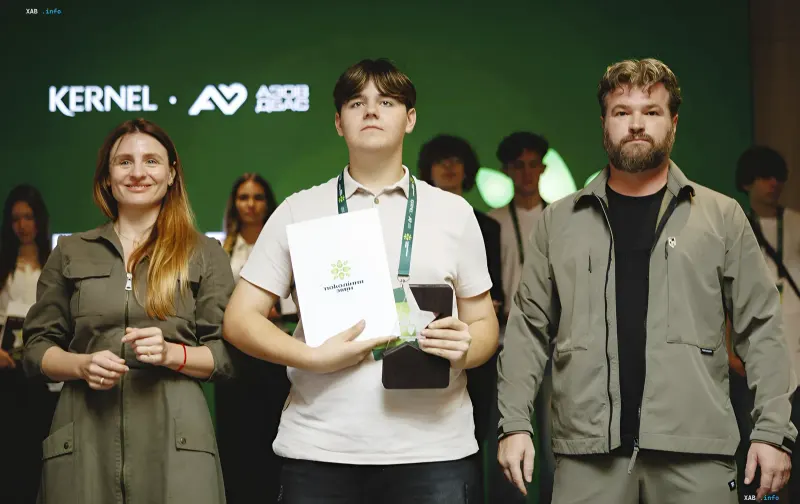
The closing event of the educational project 'Generation of Change' (Pokolinnya Zmin), launched by agriholding Kernel with the support of the 'Azov Cares' initiative, took place in Kyiv. Over the course of a year, 25 children of military personnel, guided by mentors, turned their own ideas into full-fledged research projects and prototypes — from artificial intelligence without internet access and studies of soil microorganisms to hydrogen in internal combustion engines and even a concept for terraforming Mars. Sixteen participants made it to the final presentation, where they showcased their results at the 'Kozyn' golf center, which provided the venue for the event and hosted a golf master class for the guests.
From 'I Want' to a Concrete Project
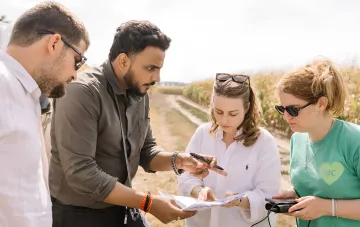
The program is built on the principle of participant autonomy: the teenagers themselves define the direction of their work, while mentors help turn their interest into a structured task. The program does not provide a ready-made list of professions or topics — each participant started with their own 'I want' and then, together with a mentor, mapped out a research path. Over the year, participants developed strategic thinking, agronomy, the basics of working with artificial intelligence, public speaking, and career guidance. A significant part of the learning was hands-on: in laboratories, on Kernel's production sites, and through consultations with the company's specialists.
Specific Projects by the Finalists
Among the presented works was Liliya's research on the properties of Trichoderma and its application in the agri-sector. The girl worked in a laboratory together with a microbiologist who helped work out the experiments. 'I had long dreamed of visiting a laboratory and trying it out. I didn't think I would have such an opportunity. It was really great, and I'm very happy,' the participant said. Dmytro chose an engineering topic: he studied the effect of adding hydrogen to the engine's intake manifold on fuel efficiency, power, and emission levels. The idea arose after a conversation with an engineer from the polytechnic institute, and his father helped him with the work. Alysa applied the program to her own passion — figure skating: she researched how to make skates lighter and has already begun working on a blade made from a lighter material. 'The idea came very easily and simply. I am definitely going to continue, because this is very important to me,' she noted.
Practice Instead of Theory
For Kernel, it is fundamentally important that participants not only gain knowledge but also apply it immediately. The teenagers could turn to the company's engineers, agronomists, biologists, energy specialists, logisticians, and IT professionals, using their expertise to develop their own ideas. According to Natalia Teryakhina, Kernel's HR Director, participants found it easier to work in areas where the company could share its technologies and practical experience. 'Broadly, the project shows that even in difficult conditions it is possible to create projects that help people develop,' she emphasized.
Systemic Support for the Families of Defenders
'For us, this is not just an educational project but systemic support for the families of defenders. We want to give children the chance to feel stability, believe in their own abilities, and see the results of their work. At the same time, we are investing in the country's future. We need a generation of researchers, entrepreneurs, and managers who can think strategically, work with real business challenges, and create new solutions,' Teryakhina stated. She also noted that Kernel already has experience working with young people: more than 400 students are studying at the Open Agro Tech University, and around 100 of them have already been employed by the company. 'Generation of Change' is a natural next step for us,' the executive added.
Context and Prospects
The 'Generation of Change' project became one of the elements of Kernel's corporate social strategy aimed at supporting the families of military personnel. The format of a one-year program with mentorship and a practical component sets it apart from short-term educational courses: participants gain not a set of knowledge but a full-cycle experience — from formulating a hypothesis to presenting a finished prototype. The closing event, held at the 'Kozyn' golf center, served as a public demonstration of the results and simultaneously as a signal to potential partners and mentors willing to join future seasons of the program.