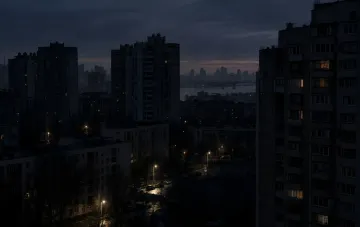
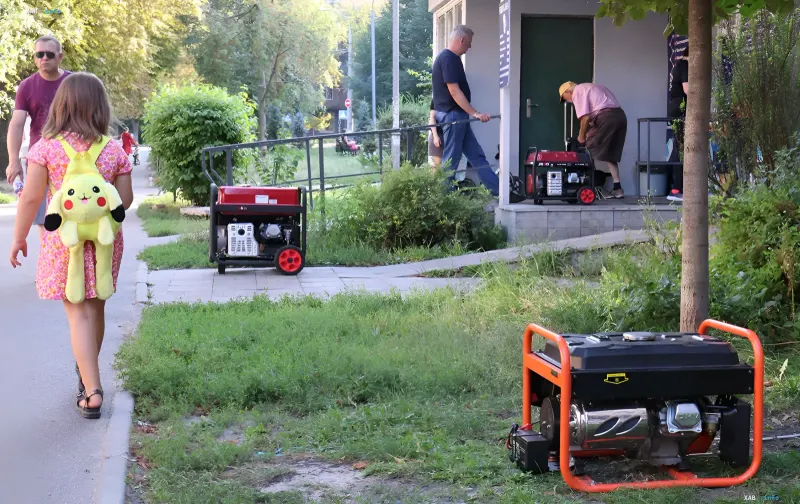
On Monday, September 14, 2026, the city of Kherson was left completely without electricity. According to RBC-Ukraine, this was announced by Yaroslav Shchanko, head of the Kherson City Military Administration, who cited an "emergency situation" as the cause of the outage. He said that at the time of his statement, specialists were already working to establish the exact cause of the power cut, and he asked residents to "treat the situation with understanding." Against the backdrop of the total blackout, backup power sources have been deployed in the city: footage from Kherson shows portable diesel generators being moved and set up in various districts to meet the basic needs of the population.
Official Position and Measures for Residents
In the midst of the outage, Shchanko reminded residents about the operation of so-called "Points of Invincibility" — specially organized locations where locals can charge their mobile devices and receive other necessary assistance. According to the statement, this measure is a standard element of the city's crisis infrastructure and is intended to mitigate the consequences of a multi-hour or longer absence of centralized power supply. The emphasis on the "Points of Invincibility" underscores that the authorities view the current blackout as a prolonged situation requiring not only technical repair but also organizational support for the population.
Context: A Series of Outages Since Early September
The current incident is not isolated. On the evening of September 8, Mykolaiv, Kherson, and a number of settlements in two regions were simultaneously left without electricity; according to Shchanko, at that time the entire territory of the hromada was without power. Thus, within a single week, Kherson experienced at least two large-scale outages, indicating a systemic vulnerability of the region's power supply under current conditions and a heavy load on emergency services and power workers.
Contradictory Data
Accounts of the nature and cause of the September 14 outage differ between sources. The official representative of the city military administration and a number of Ukrainian publications (RBC-Ukraine, Slovo i Dilo) speak of a complete blackout of the city due to an "emergency situation," the cause of which is still being established. Meanwhile, TASS describes the situation as a "partial" blackout of Kherson "after explosions," while KP reports a blackout "after nighttime shelling," with water being supplied on a schedule. Thus, two key parameters do not match: the extent of the outage (complete or partial) and its cause (a technical accident or the aftermath of explosions/shelling). Until official technical conclusions are received, both versions remain under discussion, and readers should take this discrepancy into account.
Power Workers' Efforts and Grid Restoration
To assess the scale of the load on the power system, it is important to recall data on grid restoration in the preceding weeks. Between August 31 and September 6, DTEK power workers restored electricity to nearly one million households in the Donetsk, Odesa, Dnipropetrovsk, and Kyiv regions, which had been left without power due to Russian attacks. In August, according to the same data, power was restored to nearly 4.5 million homes across four regions and in Kyiv. These figures show that the power system is operating in a mode of constant restoration after damage, making each new incident — including in Kherson — more complex in terms of the time and resources required to resolve it.
In summary: the fact of a complete power outage in Kherson on September 14, 2026, is confirmed by several sources, however its cause and exact scale remain a subject of discrepancies between official statements and data from a number of agencies. During the blackout, residents of the city can use the "Points of Invincibility" to charge devices and receive assistance, while the portable generators recorded in the city indicate the deployment of backup power supply until the full restoration of the grids.