A debate has emerged in Ukraine's defense industry over whether the new Defense Minister, Yevhen Khmara, is capable of continuing the systemic transformation of the ministry that was launched by his predecessor, Mykhailo Fedorov. Yuri Humenchuk, head of the defense company Trident Group, expressed doubt in a comment to RBC-Ukraine, dedicated to Khmara's first month in office, that the new head of the Ministry of Defense would have the time and readiness to carry the reform forward in the same vein. In his words, the key competency of a top manager at this level is the ability to put the right people into leadership positions, and it is precisely this skill, according to Humenchuk, that determines the success of the system's restructuring.
Industry assessment: "not ready for the challenge"
Humenchuk emphasized that Fedorov "consciously set out to rebuild the old Soviet-style, corrupt system into a new one — one grounded in data, oriented toward results, efficient, functional, and free of lobbying and outside influence." In his description, the vision was of a "highly organized, innovative, and extremely dynamic system" that would ensure Ukraine's victory in the current war. At the same time, the head of Trident Group stated outright: "With all due respect to Mr. Khmara, he is nowhere near ready for such a challenge. He is an exceptional officer and organizer, well acquainted with modern challenges and technologies within the scope of his work in the 'Alpha' unit. But to change the old system — that is not enough."
What, according to Humenchuk, is needed for the reform
In Humenchuk's assessment, continuing the transformation requires a clear vision, a carefully calculated strategy, a deep understanding of the environment, a core team assembled for this task, and a sufficient level of agency. "Mr. Khmara lacks these elements not because he is a poor specialist, but because he did not prepare for this task. And I am not saying he cannot prepare — it is simply that it will take a lot of time, which is not available," explained the head of Trident Group. Thus, the criticism, in his formulation, is directed not at the minister as a person, but at the lack of time and preparedness for a specific managerial task.
The "Matrix" analogy and an alternative path
At the same time, Humenchuk noted that the fact that Khmara is unlikely to be able to continue Fedorov's reforms "does not mean he cannot be effective in a different way." He illustrated his point with a reference to the film "The Matrix": "The situation here somewhat reminds me of Neo's visit to the Oracle — the fact that the Oracle did not see the chosen one in Neo does not mean he cannot become the chosen one — it all depends on him." This formulation leaves room for the new minister to find his own format for running the ministry, different from Fedorov's.
Context of the appointment and the change of leadership at the ADO
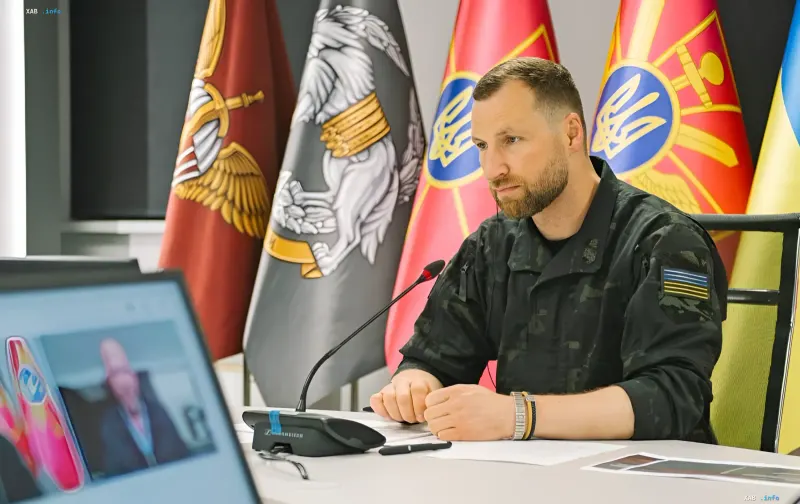
Yevhen Khmara took over the Ministry of Defense on August 19, 2026, coming to the post from a military career: prior to his appointment, he had led the SBU's "Alpha" special operations center since August 2025, and since January 2026 he had been serving as acting head of the SBU. His appointment followed the resignation of the previous minister, Mykhailo Fedorov. Additional context was created in September 2026 by the situation surrounding the Agency for Defense Procurement (ADO): the ADO's leadership changed almost simultaneously with the change of defense minister, and, in the assessment of market participants, this coincidence creates additional difficulties for coordinating procurement processes in the defense industry.
Contradictory data
Public assessment of the new minister in industry and public media is split into two opposing lines. On the one hand, the RBC-Ukraine piece, relying on the words of Yuri Humenchuk, paints a picture in which Khmara is "nowhere near ready" to continue Fedorov's reform due to a lack of time, strategy, and a formed team. On the other hand, the publication "KP" takes a directly opposite position in its headline and framing, asserting that Khmara is a "versatile defense minister" who "can do more than Mykhailo Fedorov." Thus, the same figure of the new head of the Ministry of Defense is assessed in the media field both as a manager unprepared for systemic reform and as a more versatile leader than his predecessor. These two viewpoints are incompatible in their conclusions and are presented in the article as competing assessments rather than as a single fact.