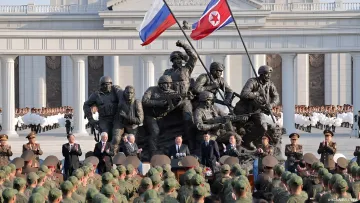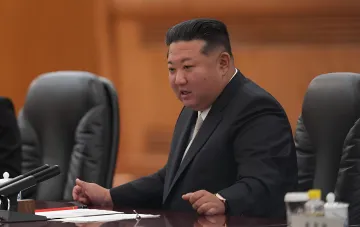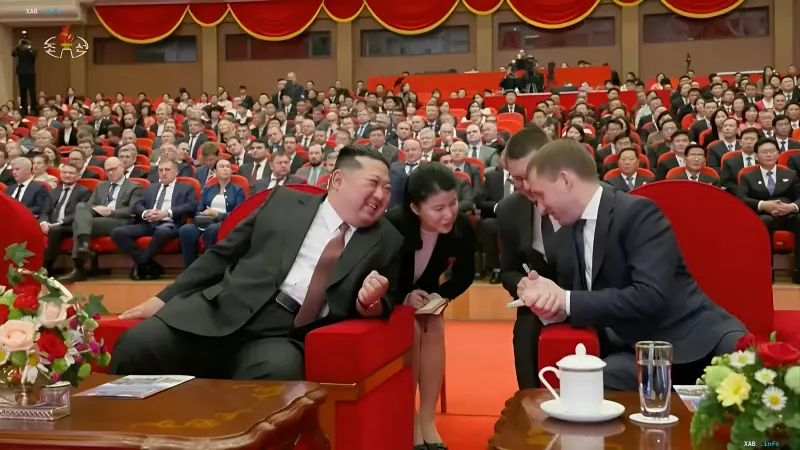
On November 26, a cultural event was held at the East Pyongyang Grand Theatre, where North Korean leader Kim Jong Un, together with his wife Ri Sol Ju, watched a performance by a Russian artistic troupe. Russian Minister of Natural Resources and Environment Alexander Kozlov was also present in the hall. According to North Korean state media, the concert became a public demonstration of the ongoing rapprochement between Pyongyang and Moscow amid expanding bilateral contacts.
Composition of the Russian Delegation and Concert Program
According to North Korean state media, the performance program featured People's Artist of Russia Larisa Dolina, Mariinsky Theatre soloist Gleb Knyazev, soloist Ekaterina Andreeva, and the Osipov Russian National Academic Orchestra of Folk Instruments. The presence of well-known Russian performers and an academic ensemble on the playbill indicates that the event was prepared as a representative cultural exchange rather than a closed screening.
Connection to the 13th Meeting of the Intergovernmental Commission
The concert was timed to coincide with the 13th meeting of the Intergovernmental Commission on Trade, Economic, Scientific, and Technological Cooperation between Russia and North Korea. This circumstance, recorded by Russian media, allows the cultural program to be viewed as part of a broader diplomatic cycle in which artistic performances accompany and support working negotiation formats on trade and economic issues.
Diplomatic Context and Significance of the Event
The attendance of the concert by the head of state and his spouse is traditionally perceived as a signal of special attention to a partner. In this case, the presence of Kim Jong Un and Ri Sol Ju at the performance by the Russian troupe, combined with the participation of the Russian Minister of Natural Resources and Environment, confirms that cultural exchange is conducted in parallel with official interdepartmental contacts. According to observers, such events serve as a tool of "soft power" and help sustain the public narrative of deepening relations between the two countries.
Reaction and Coverage in the Media Space
The event received coverage in both North Korean state publications and Russian and international media, including publications with video materials. The unified reporting line across sources is an emphasis on the friendly nature of the meeting and the participation of prominent Russian artists. No specific discrepancies in facts, dates, or participant composition were recorded between the sources.
Thus, the concert on November 26 in Pyongyang became another public episode in a series of events aimed at demonstrating the strengthening of ties between North Korea and Russia, and was integrated into the format of the 13th meeting of the Intergovernmental Commission on Trade, Economic, Scientific, and Technological Cooperation.