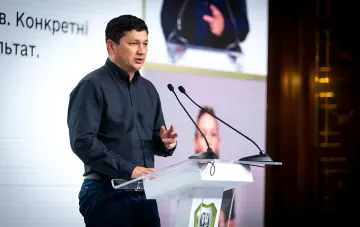
Vitaliy Kim, the newly appointed Minister for Veterans Affairs of Ukraine, in a video address dated 27 August 2026, summarised the results of his first month in office and outlined the key vectors of the ministry's reform. In his words, the priority has become optimising the ministry's structure "not for the person, but for the task," so that each function is tied to a specific result, an accountable person, and deadlines. Kim emphasised that the analysis of the ministry's work is already complete and "fully matches the Ombudsman's report," and he described his personal task as turning the department into a tool that "delivers a concrete result for veterans." As a reminder of the context: the Verkhovna Rada approved Kim for the post of minister on 16 July 2026, when Prime Minister Serhiy Korytskyy submitted the nomination for the composition of the new government.
The Forum and tasks from the leadership
The minister named the central event of the month the IX International Veterans' Forum "New Architecture of Veterans' Policy," which took place in Kyiv on 22 August, on the eve of Independence Day, and was organised by the Ministry for Veterans Affairs with the support of partners and the veterans' community. According to Kim's assessment, as a result of the forum the ministry received "clear tasks" from the President of Ukraine, the Prime Minister and, as he stressed, "most importantly — from the veterans' community itself." "Now our task is to translate everything that was said at the Forum into concrete decisions, to identify the responsible persons and the deadlines," the head of the ministry stated, thereby marking the transition from the declarative phase to the implementation stage with measurable indicators.
The loud-sound problem and a guide for organisers
As a vivid example of a "problem we saw on the ground," Kim cited an incident that occurred the other day during a concert: a serviceman had an acute reaction to loud sound, while those around him "did not know what to do." In response, the ministry, together with the Ministry of Culture, is, according to the official, "developing a simple one-page guide" with an algorithm of actions in such a situation. Kim also expressed the wish that for organisers of mass events this item become a mandatory element of preparation before the start of each event. This episode, in essence, illustrates the stated logic of the department: the state must not wait for an appeal, but proactively build up the service and the instructions.
Trips to the regions and direct dialogue
A separate block of the address was devoted by Kim to work in the field. On the eve of the publication he visited the Poltava region, clarifying that this was already his third regional trip and that they would continue: "no report can replace a real conversation, the real problems that people have." The minister listed that in the field the ministry communicates directly with veterans, servicemen, support specialists, families, communities and regional military administrations, in order to "see the whole picture and understand what is working — to strengthen, and what needs to be changed." He also reported on visits to "Azov," to the Joint Forces Operation, on meetings with the Navy and with support specialists of the Territorial Centre, adding that the best practice of these structures and the patronage services is planned to be "translated to the state level."
Digitalisation and the international track
Among the priorities Kim highlighted digitalisation and the international track, stating that "there are already results." In his words, a "large team" has been added to the ministry's team so that part of the support functions are performed by the state "on behalf of" the veteran himself. As confirmation of the international track, the minister reported that Belgium has already allocated 4 million euros for the development of digitalisation, and with other countries, according to him, there are preliminary agreements. Kim repeated the key principle of the approach: "it is not the person who, after service, must independently look for the state, but the state that must go after the person and provide the service it is obliged to."
Restructuring of the department's structure
Concluding the address, Kim linked all the steps listed — the forum, the regional trips and the direct conversations — with a specific set of tasks, for each of which, in his words, the responsible persons are being identified. "I am now changing the structure of the Ministry not for the person, but for the task, in order to implement it within specific deadlines," the head of the department declared. In a broader context, let us recall that President Volodymyr Zelenskyy previously instructed the Cabinet of Ministers to develop a new programme of support for veterans by Pokrova, which makes the optimisation announced by Kim part of a larger political mandate to restructure the entire system of veterans' policy.