Kioxia and Nvidia have jointly demonstrated an experimental system that expands the memory available to AI accelerators to 1.1 petabytes using an array of solid-state drives. The experiment was conducted on the Nvidia GB200 NVL72 platform using SCADA (Scaled Accelerated Data Access) and Storage-Next software technologies, which allow GPUs to directly access data on NVMe drives, bypassing the limitations of built-in high-performance HBM memory. According to the developers, such a configuration potentially supports working with databases containing up to 2 trillion vectors of 512 bytes each, opening up new opportunities for vector search tasks and graph neural network training.
Architecture of the Experimental Array
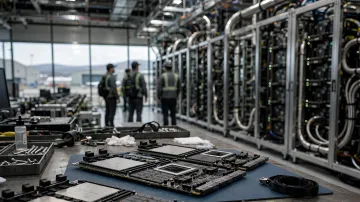
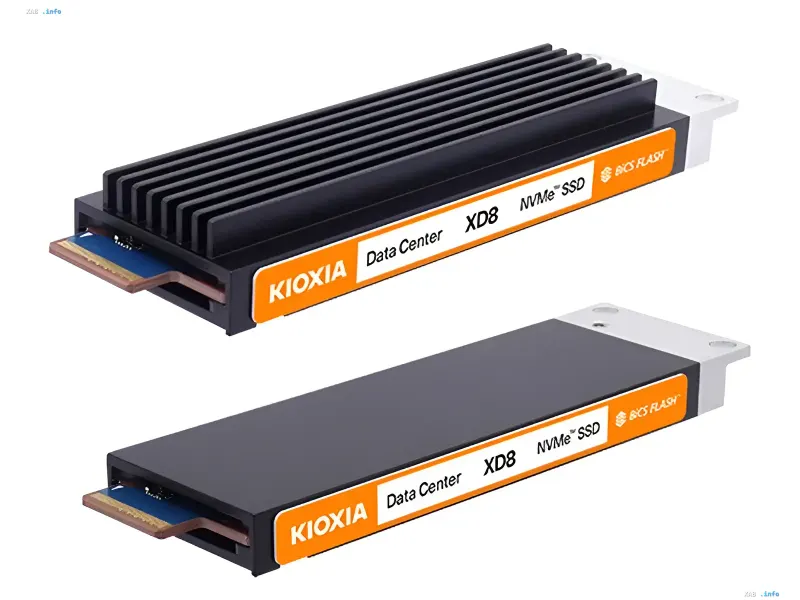
The configuration included 18 server systems and 144 Kioxia XD8 drives with a capacity of 7.68 TB each. Each node accounted for eight SSDs with a total capacity of nearly 60 TB, while the total array volume reached approximately 1.1 PB. The fundamental difference of this approach is that instead of constantly transferring data between HBM and external storage, GPUs receive an additional memory tier based on SSDs. This does not increase the physical capacity of HBM, but it makes it possible to work with datasets that do not fit into it, reducing latency when accessing 'cold' blocks of information.
New GP2 Drive Series: Specifications and Technologies
On the same day, Kioxia announced the GP2 series of specialized drives designed for intensive exchanges of small data blocks directly with GPUs. Unlike the XD8 drives used in the experiment, the new products are built on third-generation XL-FLASH memory and support the PCIe 6.0 x4 interface and NVMe 2.3 specification. According to Kioxia's internal testing, the random read performance for 512-byte blocks exceeds 18 million operations per second — almost double the figure of the previous GP1 series. The expected sequential read speed reaches 28 GB/s, and endurance is up to 50 drive writes per day (DWPD). The developer also reported that using XL-FLASH provides approximately 2.5 times more random read operations compared to CM10 series SSDs based on TLC memory.
Form Factors, Cooling, and Production Plans
Kioxia is considering releasing GP2 models in E1.S form factors with a thickness of 9.5 mm and E3.S with direct liquid cooling support, which is critical for high-density server racks. However, the GP2 drives are not yet in mass production: the company plans to provide the first samples for functional testing to select customers by the end of 2027. The stated speed of up to 28 GB/s remains an expected metric, and the final specifications of commercial devices may be adjusted based on testing results.
Strategic Context: The Path to 100 Million IOPS
In October of this year, Kioxia already demonstrated an experimental GP-family SSD with performance exceeding 20 million IOPS. Going forward, the company intends to bring this figure to 100 million operations per second to significantly accelerate AI accelerators' access to large datasets. For now, this is a proof-of-concept: Kioxia and Nvidia continue to evaluate the capabilities of SCADA and Storage-Next, including system performance when processing large volumes of data, while specific speed measurement results were not disclosed in the public report.
Significance for the AI Infrastructure Industry
The demonstration by Kioxia and Nvidia highlights the growing memory deficit as a key bottleneck in AI system architecture. As model parameters and training data volumes grow, the traditional 'HBM — DRAM — SSD' hierarchy is transforming: SSDs are ceasing to be purely storage and are becoming a full-fledged working memory tier for GPUs. If SCADA/Storage-Next technology gains widespread adoption, it could change server platform requirements and unlock a new class of tasks — from retrieval-augmented generation on trillion-vector indices to distributed graph neural network training that were previously limited by the HBM capacity of a single node.