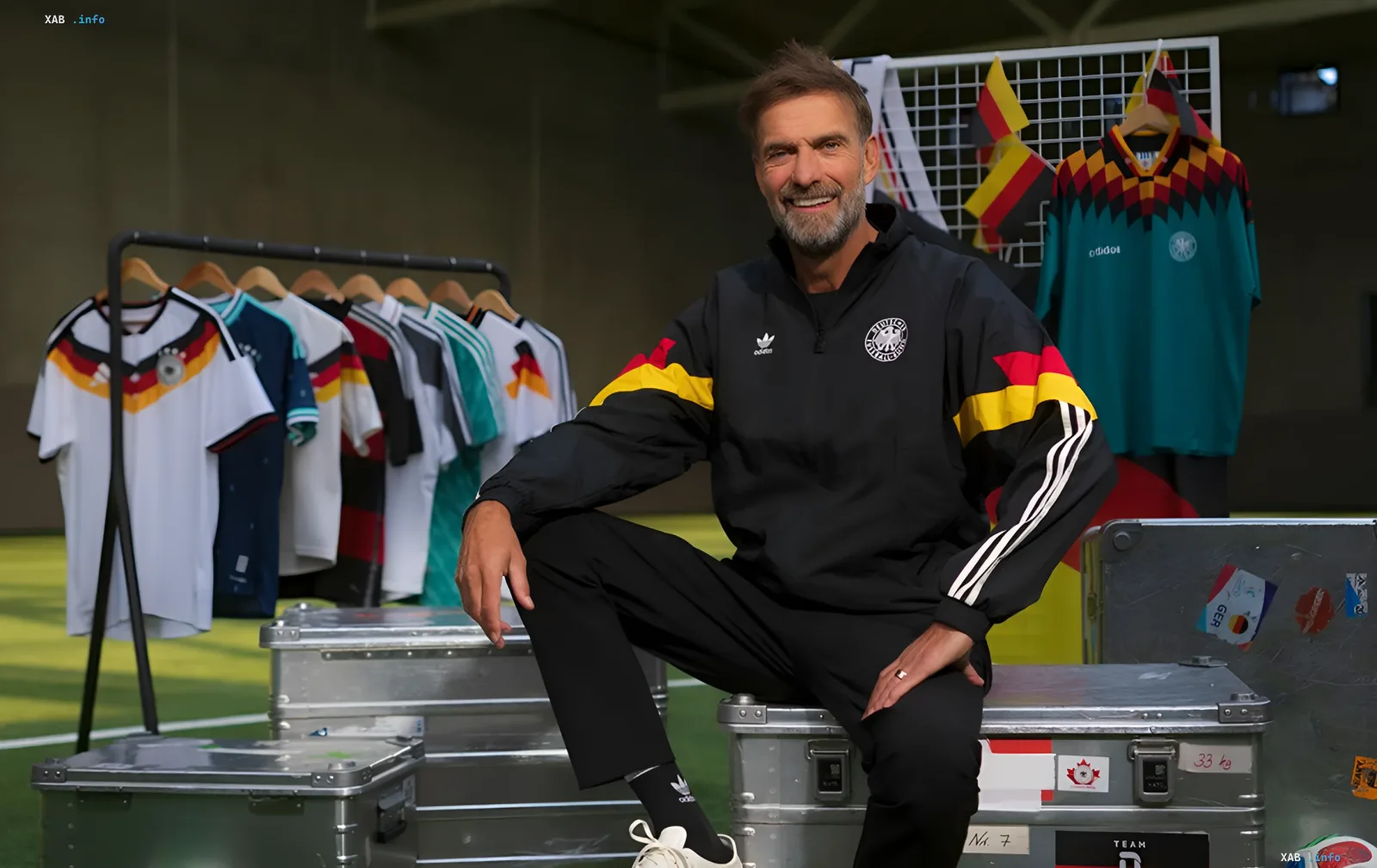
Germany head coach Jurgen Klopp has announced an extended squad of 44 players for the September and October Nations League matches. For the 59-year-old, these are his first official games in charge of the national team, and the very format of preparation has been unconventional: instead of the usual single squad, the coaching staff has put together two fundamentally different groups of 22 players for each pair of matches. This is reported by Sport RBC.UA, citing the official Bundesteam Instagram post.
Why two squads for one window
The reason for this structure is purely calendar-related. In League A of the Nations League, Germany has to play four matches within a single international window: against the Netherlands and Greece in September, and against Serbia and Greece in October. To avoid keeping the same pool of players under load for two weeks with four matches, Klopp's staff split the squad into two groups of 22. The overlap between them is minimal: the only player to make both lists is Augsburg goalkeeper Finn Damen.
Debutants and key names in both squads
Among the 44 called-up players is a group of debutants receiving their first call-up of their careers. The September squad (matches against the Netherlands and Greece) is headlined by Bundesteam mainstays such as Kai Havertz, Jamal Musiala, Joshua Kimmich and Marc-Andre ter Stegen. The October roster (matches against Serbia and Greece) is strengthened by Florian Wirtz, Karim Adeyemi, David Raum and Nick Woltemade. Thus, each pair of matches received its own set of stars, which in itself is a signal of Klopp's intention to cover as wide a pool of candidates as possible.
Who was left out of the squad
Not all expected names made the extended 44-man squad. In particular, Deniz Undav and one of the season's most productive defenders, Matthias Ginter, were not included. Their absence from such a large call-up was a notable squad decision, which the coaching staff explains by the logic of distributing the workload and tactical tasks across two different pairs of matches.
Klopp's stance
Jurgen Klopp himself stated directly that the unusual calendar is his main asset for getting to know the team. "It's very unusual to have four matches in two weeks with the national team. I want to get to know as many players as possible during this time. I want to bring attention back to the Bundesteam so that fans are proud of their country again," the coach said. These words set the tone for Klopp's entire first cycle: a focus on wide rotation, competitive selection and restoring the team's image in front of the fans.
Contradictory data
Publications in Ukrainian sports media disagree on the number of debutants in the squad. The main text of the Sport RBC.UA report points to 11 debutants among the 44 called-up players. At the same time, sport.nv.ua, in its headline and framing, speaks of "44 players and 13 debutants." The difference of two people may be linked to how exactly the editors count "debutants" — for example, whether they included players who had previously been in extended or Olympic squads, or players making their first appearance in a specific one of the two subgroups. The fact of 44 footballers being called up and two squads of 22 being formed is confirmed by all sources; the discrepancy concerns only the exact number of newcomers, which at the time of publication is either 11 or 13 depending on the source.