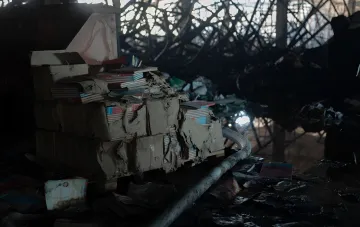
Russian strikes on Ukraine's publishing and printing infrastructure have put the timely preparation of school textbooks for the new academic year at risk. In response, the government has established a backup scenario: if it proves impossible to print and deliver the required number of paper editions within the set deadlines, students must be given access to their electronic versions. This was announced by Ukrainian Prime Minister Serhiy Koretsky in a Facebook post, commenting on the consequences of the recent attacks on warehouses and printing houses, according to RBC-Ukraine.
The Prime Minister's directive: electronic textbooks as a backup option
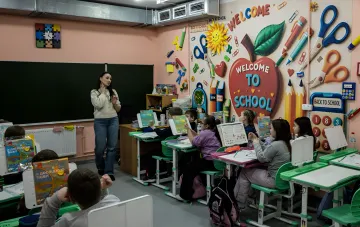
Koretsky tasked the Ministry of Education and Science, together with local authorities, with ensuring that students are provided with electronic versions of textbooks in cases where Russian strikes prevent them from being printed or delivered to schools in a timely manner. As the Prime Minister emphasized, the decision must be made taking into account the situation in each specific region — that is, without a single "nationwide" format, but with regard to local capabilities and risks. Thus, digital textbooks are officially established not as a default replacement for paper ones, but as a tool for the continuity of education under conditions of military threat.
Attacks on publishing infrastructure
The backdrop for this decision was specific destruction. According to the data underlying the article, a Russian attack on August 28 destroyed a warehouse in Svyatopetrivske, Kyiv Oblast, where thousands of books from the publishers Vivat, Readeat and Book.ua were stored. The publisher Vivat, according to available information, continues to operate, while Readeat has temporarily suspended order shipments in order to assess the consequences of the strike. On the same night, as is reported, Russian troops destroyed a consignment from the publisher "A-ba-ba-ga-la-ma-ga": the premises burned down completely along with a significant number of books. The cumulative effect of these strikes is a breakdown in the "printed — delivered — handed to the student" chain.
Contradictory data
It is important to honestly note the discrepancy in details between sources. In the primary text (citing RBC-Ukraine), the August 28 strike is described as the destruction of a warehouse in Svyatopetrivske, Kyiv Oblast, with "thousands of books" from Vivat, Readeat and Book.ua, as well as the burned consignment of "A-ba-ba-ga-la-ma-ga". At the same time, the source kp.ua (ID 2) reports a Russian strike on the "Konvi" printing house in Kyiv, as a result of which nearly 250,000 textbooks burned. That is, in terms of scale ("thousands" versus "nearly 250,000") and the exact location/name of the facility (a warehouse in Svyatopetrivske versus the "Konvi" printing house in Kyiv), the versions do not match. Both versions may be correct if they refer to several facilities hit on the same night in the Kyiv agglomeration; however, the primary text mentions neither "Konvi" nor the figure of 250,000, while kp.ua does not name Svyatopetrivske or the listed publishers. Until the exact figures and addresses are clarified, the scale of textbook losses should be regarded as a range rather than a single number.
School feeding: ready-to-eat food under security threats
Separately, the Prime Minister raised the issue of children's nutrition. In schools where security conditions do not allow for the organization of full hot meals, students must be provided with ready-to-eat dishes. "The issue of quality nutrition is a priority," Koretsky emphasized. According to him, the Ministry of Education and Science must keep the situation with school feeding under control and ensure the necessary solutions taking into account the security situation in each region.
What this means for the regions
The practical conclusion from the directive is a shift from the centralized "one print run for the whole country" model to regional flexibility: MON and local authorities must assess where a paper print run is still possible and where the only workable option is digital access. This requires not only the availability of electronic versions of textbooks, but also the infrastructure for their delivery to schools and to students (devices, internet, offline copies). Under conditions of ongoing strikes on logistics and printing, such a scenario effectively becomes not a backup, but one of the main tools for ensuring the right to education in the coming months.