Ukraine's book market is going through an unprecedented crisis. Russian strikes on the warehouses of the country's largest publishers have, within two months, led to the destruction of up to 15 million book copies — nearly half of the country's annual output. According to RBC-Ukraine, the attacks destroyed 9% of new school textbooks. Andrey Shironos, editor-in-chief of the Bookchef publishing house, emphasizes: "A book shortage is not a potential risk. It is already here. We are among the top five publishers. The destruction of our warehouses and our colleagues' warehouses is already affecting the market." According to publishers, the issue is not the complete disappearance of books from shelves, but a systemic shortage of individual titles, rising prices, and a significant increase in wait times for reprint runs.
The scale of the losses: figures that are changing the market
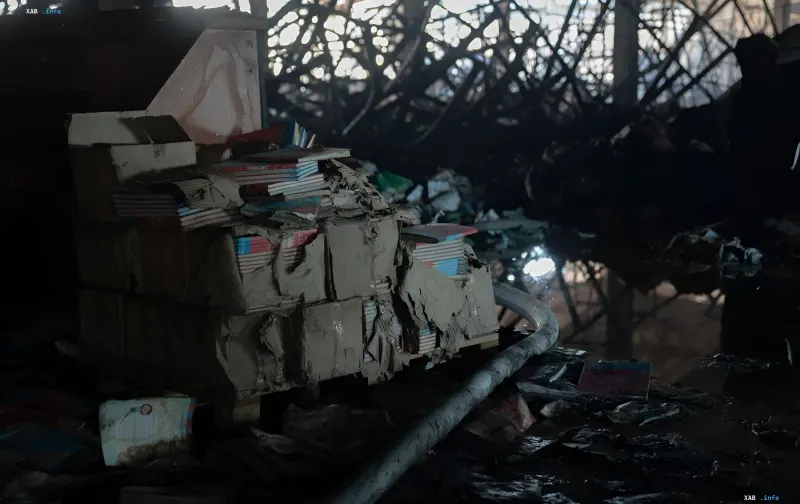
Industry estimates cited in the RBC-Ukraine article "We will still fight" record colossal damage: up to 15 million copies were destroyed over two months of active attacks. For context — this is comparable to nearly 50% of the annual print run of Ukrainian publishers. The loss of 9% of new school textbooks is highlighted separately, posing a direct threat to the educational process in the new 2026/2027 school year. On the night of August 28, 2026, Russia destroyed the warehouse of the "A-ba-ba-ga-la-ma-ga" publishing house, and that same evening thousands of books belonging to nearly three dozen popular Ukrainian publishers burned down. This is not an isolated incident: on July 2, 2026, the central warehouse of BookChef's logistics partner was hit, where 800,000 books burned, and on August 5 a Russian attack destroyed another Bookchef consignment — more than 100,000 copies.
What publishers are saying: reduced print runs and a narrower range
Yulia Orlova, CEO and co-founder of the Vivat publishing house, explains the mechanics of the crisis: "Many publishers currently lack the working capital to quickly reprint all the books that are running out. We see this in the case of Vivat as well. We have to reduce both the number of titles and the print runs." According to her, individual books may temporarily disappear from shelves, and the gap between the end of a print run and a new printing will become significantly longer. At the "Nash Format" publishing house, the main risk is formulated differently: "We are more likely to see a situation where certain titles will be unavailable for a period of time, we will wait longer for reprints, or the releases of new books will be postponed. Therefore, the main risk is not the complete absence of books, but that they will be more expensive, come out more slowly, and the range will narrow."
Chronology of attacks on the book infrastructure
The systematic nature of the strikes is traceable by date. July 2, 2026 — attack on the central warehouse of BookChef's logistics partner, 800,000 books destroyed. August 5, 2026 — destruction of another Bookchef consignment, losses exceeding 100,000 copies. On the night of August 28, 2026 — simultaneous destruction of the "A-ba-ba-ga-la-ma-ga" warehouse and a warehouse storing books from nearly 30 Ukrainian publishers. In parallel, as reported by RFI and Liga.net, in mid-August 2026 the largest book market on Pochaina in Kyiv burned out after a Russian missile strike, depriving the market of yet another key channel of distribution and retail.
Contradictory data
Significantly different estimates of the scale of the catastrophe are circulating in the media space. In an article dated August 16, 2026, RFI uses the headline "The history of the book market is over," characterizing the state of the market on Pochaina as virtually complete destruction. The press service and industry experts in the RBC-Ukraine article, by contrast, insist that this is not a collapse but a shortage and price increase: "The main risk is not the complete absence of books, but that they will be more expensive and come out more slowly." The figure of 15 million copies is also presented as an upper bound ("may reach") rather than a confirmed inventory result. Thus, one side records the local destruction of key distribution points, while the other describes structural but reversible consequences for the supply chain. The final assessment of the actual losses may be revised as the count is completed.
What this means for the reader
For the end consumer, the consequences are already manifesting in three dimensions. First, rising prices: reducing print runs while print costs remain the same automatically raises the retail price. Second, a longer waiting cycle: more time passes between the sell-out of a print run and the appearance of a reprint, creating "gaps" on the shelves. Third, a narrower range: publishers are forced to choose which titles to reprint first and which to temporarily postpone. Publishers emphasize that the market has not stopped, but is operating in survival mode, and the restoration of working capital will be the key condition for returning to previous output rates.