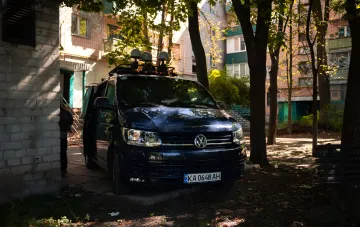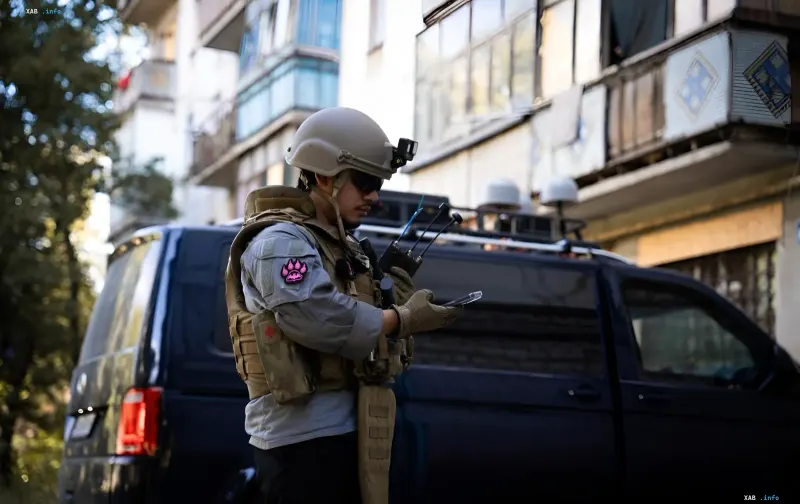
In Kramatorsk, everyday life for those working on the front line of civilian evacuation has long ceased to be safe. According to 26-year-old Anna Elsbrind, head of the international evacuation team Universal Aid Ukraine, even a trip to an ordinary supermarket now requires an armored vehicle and a portable drone detector called "Chuyka." She told this in an interview with Tsenor.NET, as cited by RBC-Ukraine. Anna has lived in Kramatorsk since the beginning of 2023 and spends about 11 months a year in Ukraine, traveling to Germany mainly for Christmas.
Armored vehicle and drone detector — the new normal
According to the volunteer, FPV drones attack vehicles on the city's main roads, and danger can arise at any moment. "We have to drive to the supermarket with an armored vehicle and a 'Chuyka' detector," Anna says. The team is forced to constantly watch the sky, hide from drones and change routes, and it is practically impossible to determine when it is "safer" in the city: attacks occur suddenly, and the drones fly so fast that a person may not have time to notice the threat and react.
"Drones are following us"
The problem is felt most acutely while moving around the city and its surroundings. "Drones are following us; we can see our car on the tracker, and the drone keeps following it. We need to outrun the drone and be faster. Or hide from it," Anna recounts. She notes that she no longer remembers a single evacuation during which the team did not see a drone, and emphasizes that even an ordinary move around Kramatorsk requires constant awareness of the threat of a strike.
Evacuation: responsibility for other people's lives
The hardest stage is the evacuation of civilians. As soon as people get into the vehicle, the team is responsible not only for its own safety but also for the lives of the passengers. The volunteers may themselves feel fear, but they are obliged to stay calm and reassure people that everything will be fine. In 2025, according to the organization's own data, Universal Aid Ukraine evacuated 1,200 civilians from dangerous areas; its teams are now working in Kramatorsk, Sloviansk, Malotaranivka, Druzhkivka, as well as in the Dnipropetrovsk region.
A city that is emptying
Despite the daily danger, Anna calls Kramatorsk her favorite city in Ukraine — "honest, real and connected to many personal moments" — recalling the nature of the Donbas, the fields, forests, water bodies and the night sky. At the same time, she sees how the city, which has become her home over three and a half years, is gradually emptying, and right now she cannot leave it: a mandatory evacuation is underway, and more and more people need help. "I am evacuating my neighbors, and my brain never rests," the volunteer admits, naming the inability to even briefly take her mind off the war as the main source of exhaustion.
Contradictory data
The key figures and estimates in the material — in particular, the figure of 1,200 evacuees in 2025 and the claim that "no evacuation took place without drone observation" — are based exclusively on Anna Elsbrind's personal testimony and are not confirmed by an independent second source. The wording in the photo caption that the city became her home "over three and a half years" is consistent with the statement about moving in at the beginning of 2023 given the current date of September 2026, but the exact count depends on interpretation. In addition, the database of verified sources contains publications about an armored vehicle in the context of a different person and a different event, which are unrelated to the story of the Kramatorsk volunteer and should not be mixed with this material.