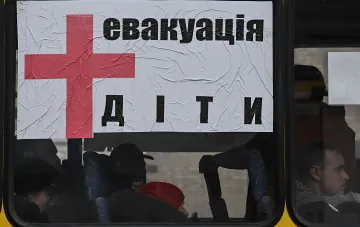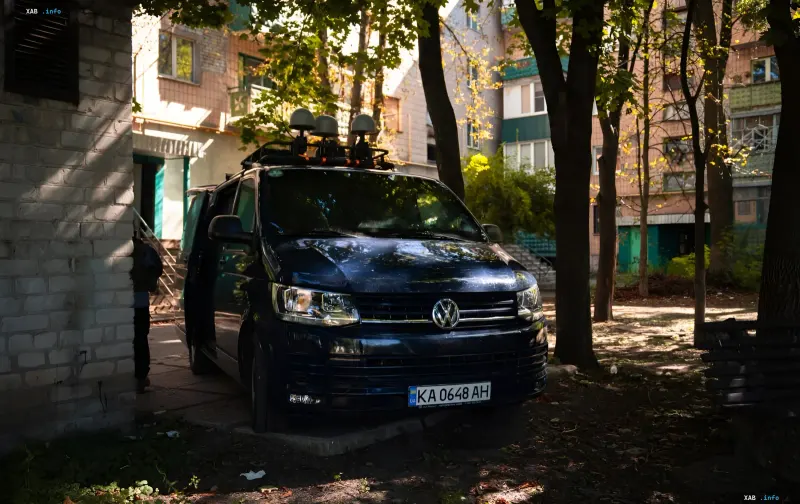
The Association "United "Ukrainian Defense Industry" (NAUDI) has handed over a four-wheel-drive Volkswagen Transporter, equipped for evacuating civilians from frontline areas, to two German volunteers — Ricarda Fazzol and Anna Elsbernd. This became known from a post on NAUDI's official Facebook page, which was cited by RBC-Ukraine and Telegraf. The vehicle has already begun operations in Sloviansk, where it completed its first evacuation run, and will subsequently be deployed on humanitarian missions in the Kramatorsk direction area.
The vehicle is already in service: first run out of Sloviansk
The handed-over Volkswagen Transporter is a four-wheel-drive minivan fitted with additional roof-mounted equipment — specifically, three round floodlights — which allows it to be used in conditions of limited visibility and on off-road terrain. According to NAUDI, the vehicle is already in Sloviansk and has carried out its first evacuation trip. Going forward, the vehicle will be used on a regular basis to transport civilians out of danger zones and to carry out humanitarian missions on the Kramatorsk direction, where, according to local authorities, the need for evacuation resources remains high throughout the period of hostilities.
German volunteers and the "Universal Help for Ukraine" foundation
The vehicle was handed over in the name of Ricarda Fazzol and Anna Elsbernd, who heads the charitable foundation "Universal Help for Ukraine." The organization has been operating in eastern Ukraine since 2022 and, according to its own data, has evacuated around 1,200 civilians from danger zones over the past year. For the foundation, obtaining its own evacuation vehicle means reducing dependence on rentals and logistical delays, which is critically important when operating in conditions where windows for safely leaving settlements can last only a matter of hours.
NAUDI's role and the association leadership's position
NAUDI brings together 175 companies of the Ukrainian defense-industrial complex and, in addition to tasks related to supporting the Defense Forces, carries out systematic work to ensure humanitarian missions in frontline regions. The head of the association, Serhiy Pashyn, commented on the handover of the vehicle as follows: "It is important to us that support for Ukraine is not just words, but concrete help that saves lives every day. The vehicle we handed over to the volunteers will help transport civilians out of danger zones. This is yet another example of how the combined efforts of Ukrainian business and foreign volunteers can directly help people." Thus, NAUDI positions the handover of the vehicle not as a one-off event, but as an element of a long-term model of interaction between the Ukrainian industrial sector and the international volunteer community.
Broader context: the humanitarian crisis in the east
The handover of evacuation vehicles to the Kramatorsk direction comes against the backdrop of sustained demand for humanitarian logistics in Donetsk Oblast. Settlements near the front line continue to come under shelling, forcing civilians into repeated evacuations. In this situation, having specialized four-wheel-drive vehicles capable of operating in conditions of destroyed infrastructure and poor roads becomes not just a convenience, but a factor determining the speed and safety of evacuating people. The experience of the "Universal Help for Ukraine" foundation, with more than four years of continuous work in the east, confirms that it is often local and international volunteer teams that take on tasks that state structures are unable to carry out in sufficient volume.
What comes next
According to available data, the Volkswagen Transporter will remain at the disposal of the volunteer foundation and be used on a regular basis. NAUDI, for its part, confirms its intention to continue supporting humanitarian missions in frontline regions, relying on the resources of the enterprises that are members of the association. For the German volunteers, obtaining their own vehicle means a shift from a model in which they depended on third-party vehicles to a model of autonomous operational response — which, by their own estimates, reduces the time from receiving a signal that evacuation is needed to actually departing for the settlement.