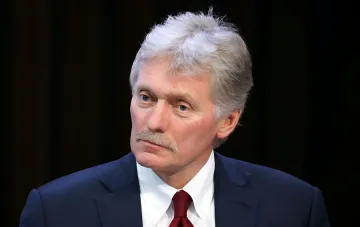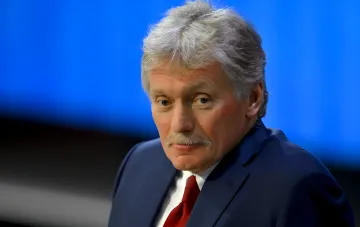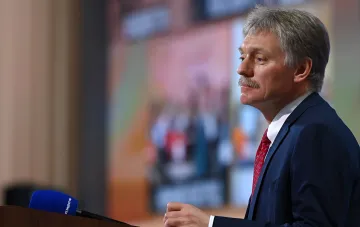

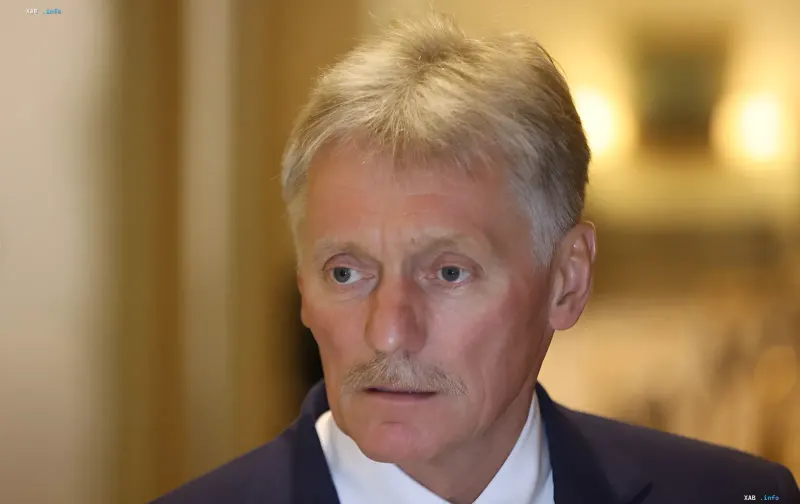
Moscow has outright rejected the proposal to create a free economic zone (FEZ) in Donbas, which is being discussed as part of a joint peace plan by Ukraine, the US and the EU. This was stated by Kremlin spokesman Dmitry Peskov, according to RBK-Ukraine citing Interfax. His remarks came as a direct response to a recent speech by Ukrainian President Volodymyr Zelenskyy, who on August 23 outlined one of the scenarios for a ceasefire.
Kremlin's Reaction: 'Donbas Is a Subject of the Russian Federation'
In his comment, Peskov, according to the source, insisted that the entire Donbas is allegedly part of Russia and that the region cannot be administered by any third party. 'In this context, I would still say that Donbas is the territory of the Russian Federation, a subject of the Russian Federation. (...) And it is unlikely that some third party could be involved in administering the regions of the Russian Federation,' the spokesman stated. Thus, Moscow has effectively rejected the very logic of the buffer zone proposed by Kyiv and supported by American mediators.
Zelenskyy's Initiative and the Role of American Mediators
Earlier, the Ukrainian president explained that one of the scenarios for ending the war could involve the creation of a free economic zone in Donbas under the control of a third party. According to him, special envoys of US President Donald Trump — Steve Witkoff and Jared Kushner — are putting forward 'real scenarios' for ending the war, which are planned to be discussed not only with Kyiv but also with Moscow. 'To put it briefly, there is one of the ideas for a ceasefire — that is the main thing there. The second part is what the Americans proposed regarding the free economic zone. That is, we and the 'Russians' take the same steps back, and this creates such a buffer, which is called a free economic zone under some kind of administration. It is not yet clear under whose, but it is some kind of third party,' Zelenskyy explained on August 23, calling the format 'complex, but fair.'
What Exactly Is Being Proposed: A Local Buffer, Not a Trade Agreement
It is important to clarify the terminology: this is not about a large-scale interstate free trade agreement, but about a local initiative concerning the combat zone itself. The idea is for both sides to withdraw to comparable positions, with the resulting 'buffer' placed under the administration of a neutral third party, which should reduce the risk of new clashes and create conditions for a ceasefire.
Contradictory Data
The positions of the parties on the key question are fundamentally at odds. Kyiv and the American mediators view Donbas as a territory where a zone under the administration of a third party could be established, that is, as a subject of a future settlement. Moscow, on the other hand, through Peskov, asserts that the region is already a 'subject of the Russian Federation' and therefore cannot be administered by anyone other than Russia. These two versions are incompatible: one assumes external neutral control, the other — Moscow's exclusive control. Moreover, there is no single agreed text of the 'joint plan of Ukraine, the US and the EU' with fixed FEZ parameters in open materials, so the specific terms (the zone's boundaries, the composition of the 'third party,' timelines) remain undefined and are described differently by the parties.
Context: Statements on Threats to the UK and on OZON
In addition to the reaction to Zelenskyy's plan, the Kremlin, according to RBK-Ukraine, also publicly threatened the United Kingdom during the same period following London's new decision on Ukraine. Peskov also announced 'revenge' for the Ukrainian military's strikes on the OZON marketplace, stating that Kyiv would suffer the most. These statements complement the picture of Moscow's overall rhetoric, which combines the rejection of the buffer zone with an escalation of threats toward Western countries.