The massive airstrike on the night of August 20, 2026, once again demonstrated the tactic of combined saturation of the capital’s air defense node. The combination of dozens of slow decoy drones with salvo launches of high-speed ballistic missiles creates an extreme load on surface-to-air missile systems, forcing operators to distribute limited ammunition between heterogeneous targets moving at fundamentally different speeds and altitudes within just a few minutes. According to eyewitnesses, air raid sirens in Kyiv sounded for several hours, while official agencies recorded all available air defense systems operating at maximum capacity.
Interception Statistics According to Air Force Briefings
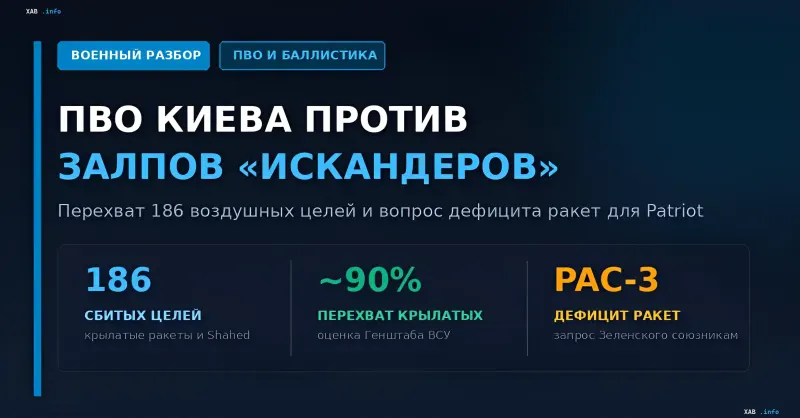
According to official briefings from the Ukrainian Air Force command and data from The Guardian, air defense units destroyed 186 aerial targets. Of the 44 launched cruise missiles, 39 were intercepted, corresponding to an effectiveness of approximately 90 percent. 145 Shahed-type attack drones were destroyed out of 168 launched. Two guided missiles of the "Banderyol" type were shot down. Command emphasizes that a significant portion of the destroyed objects were specifically drones intended to distract and exhaust air defense systems before the main salvo of ballistic missiles.
Ballistics and the Time-of-Flight Problem
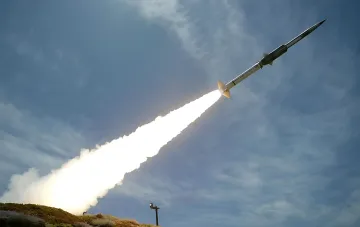
Intercepting ballistic trajectories, particularly Iskander-M missiles (index 9M723), remains the most challenging task for current systems. The flight time from the borders of the Bryansk and Kursk regions to Kyiv ranges from two to four minutes, leaving only seconds for SAM radars to lock onto the target and guide the interceptor. On the terminal section, the ballistic missile enters the atmosphere at hypersonic speed, and the window for the interceptor to maneuver is extremely narrow. This is why the share of intercepted ballistic targets in the overall statistics remains lower than that of cruise missiles and drones.
PAC-3 Missile Shortage and Zelenskyy's Statement
MIM-104 Patriot systems with PAC-3 MSE interceptor missiles (kinetic target destruction) and French-Italian SAMP/T systems remain the only systems capable of reliably intercepting ballistic missiles on the terminal section. President Volodymyr Zelenskyy, in his morning statement, directly pointed to the critical need to accelerate the supply of missiles for Patriot systems: "We need additional missiles for the Patriots. Every massive airstrike consumes a significant portion of the anti-missile arsenal, and delays in supplies directly cost human lives," Obozrevatel quotes him. The statement came against the backdrop of ongoing negotiations with allies about expanding military supplies.
Change in Enemy Tactics: Signatures and Maneuvering
Analyst materials indicate that the Russian side is adapting the tactics of using ballistics taking into account the characteristics of Ukrainian air defense. According to data provided in a focus.ua publication, Russia has obtained Patriot system signatures, which allows for adjusting Iskander missile trajectories and flight modes to bypass engagement zones. A journalist cited by zn.ua explains the reduced interception rate of ballistics precisely due to the change in tactics: the enemy uses combined salvos where ballistic missiles are launched simultaneously with cruise missiles and drones, overloading guidance channels and creating false targets. This means that even with a sufficient number of interceptors, effectiveness may decrease due to tactical saturation.
Contradictory Data
There are significant discrepancies between official briefings and publications by several Russian media outlets regarding the assessment of events. In materials from news.mail.ru and life.ru, dedicated to earlier strikes (specifically events of July 20), formulations regarding "panic" in Kyiv and a "ban on data about strikes" are used, which contradicts the open publication of detailed interception statistics by the Air Force. Meanwhile, official Ukrainian agencies publish a breakdown by target type and the number of objects shot down, including data verified by international media. The difference in narratives is due to the fact that Russian sources focus on the number of objects that reached their targets and the assumed damage, whereas Ukrainian briefings record the number of intercepted targets. Independent verification of the exact number of ground hits under martial law remains limited.
Thus, the night attack on August 20, 2026, confirmed a stable trend towards combined massive strikes, where ballistics play the role of the main damaging element, while drones and cruise missiles serve the function of saturation. The key factor determining the effectiveness of air defense in the future remains not only the tactical training of operators but also the pace of replenishing the anti-missile arsenal, primarily PAC-3 missiles for Patriot systems.