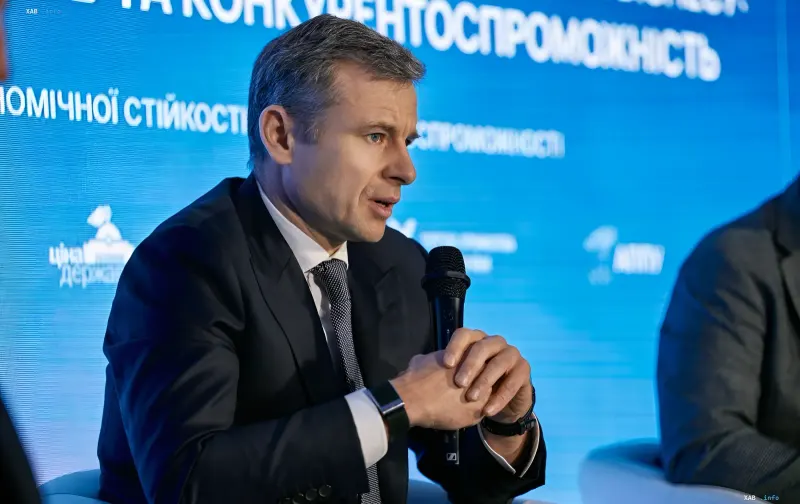
Kyiv hosted the forum “Dialogue between Government, Civil Society, and Business — Economic Resilience and Competitiveness,” where approximately 150 representatives from the government, parliament, business associations, and expert community discussed key economic and tax changes for 2027. The agenda included state budget revenue, tax policy, European integration reforms, support for enterprises affected by Russian shelling, and war risk insurance mechanisms. This is reported by RBC-Ukraine with reference to a press release from the Ukrainian Business Council (UBC).
Financial Balance: Two Perspectives on a Single State
Assessments of the state of public finances voiced at the forum varied noticeably in tone. Minister of Finance Sergii Marchenko stated that the situation on the single treasury account remains controllable, VAT refunds are being made in full, and international financial support together with taxes continuously paid by businesses allow the state to plan the 2026–2027 period with greater confidence. Daniil Hetmantsev, Head of the Parliamentary Committee on Finance, Tax, and Customs Policy, conversely described the state of public finances as “critical”: own tax revenues currently cover only about 30% of budget expenditures, whereas at the beginning of the full-scale war this figure exceeded 60%. “If we talk about the strategic priority for 2027, that priority is to endure. To survive,” Hetmantsev stated.
Joining SEPA as Savings for Business
The Minister of Finance paid special attention to Ukraine’s accession to the Single Euro Payments Area (SEPA), which he said will simplify international settlements and reduce costs for entrepreneurs. According to Ministry of Finance calculations cited by Grigol Katamadze, President of the Association of Taxpayers of Ukraine, joining SEPA could provide Ukrainian businesses with annual savings ranging from 70 to 100 million euros.
Restoration of Affected Enterprises and the New Business Support Fund
One of the key topics was the restoration of enterprises that suffered losses due to Russian attacks. Mykhailo Nepran, First Vice President of the Ukrainian Chamber of Commerce and Industry, reported that in September and October alone, the chamber received about 300 applications regarding force majeure certification, while establishing a full-fledged asset recovery fund requires, by his estimate, finding funding sources amounting to 65–85 billion hryvnias. Deputy Minister of Economy and Environment Yegor Hryhorenko presented a model for the new Business Support Fund, which provides for war risk insurance and the expansion of investment lending for medium and large enterprises. The government expects to mobilize about $1 billion in internal resources without increasing the VAT rate, as well as attract an additional $2–3 billion from international partners and the global reinsurance market.
Regulatory Barriers and Draft Law No. 16213
Business representatives drew attention to regulatory restrictions complicating enterprise operations. Member of Parliament Yaroslav Zheleznyak criticized chaotic rule changes for entrepreneurs, in particular the introduction of new shelter-equipping requirements which, in his view, could create additional problems for small cafes, shops, offices, and enterprises in frontline regions. Forum participants also raised the issue of employee reservation and tax compensation for goods destroyed as a result of shelling: Draft Law No. 16213 was discussed, providing mechanisms for the return of VAT and excise duties on destroyed products, the cancellation of fines for lost documents, and the write-off of taxes on destroyed goods.
De-shadowing the Economy as a Priority for 2027
Forum participants identified the de-shadowing of the economy as another priority for 2027. According to Daniil Hetmantsev’s estimate, the shadow sector in Ukraine amounts to about 1.3 trillion hryvnias. At the same time, the MP emphasized that even complete de-shadowing cannot compensate for the need for international financial support, which is estimated at approximately $54 billion annually. The necessity of establishing clear criteria for business splitting to counteract tax evasion schemes without placing additional pressure on conscientious entrepreneurs was discussed separately.