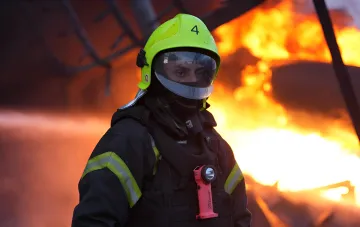

On the night of 27 August 2026, the capital of Ukraine came under a ballistic missile strike. The Air Force of the Ukrainian Armed Forces warned of a missile heading from the Chernihiv region toward Kyiv, and shortly afterward reported another target making its way to the capital. Following the alerts, a series of explosions was heard in the city and an air raid was declared. This is reported by RBC-Ukraine, citing the Air Force of the Armed Forces of Ukraine and the Kyiv City Military Administration (KCMA), as well as a number of Ukrainian and foreign media outlets.
Timeline of the Night Attack
According to the Air Force, the attack unfolded in waves: first, the approach of one ballistic missile from the direction of the Chernihiv region was detected, followed by another. Command also reported a new wave of ballistic missiles launched toward the capital. It was after these warnings that explosions rang out in Kyiv. Ukrainian media characterize the event as a massive ballistic missile strike on the capital, accompanied by explosions and fires.
Falling Debris in Kyiv Districts
The Kyiv City Military Administration reported that debris fell in the Podil district — it landed in the courtyard of a residential building. Information on casualties and the extent of damage in this area is being verified. Separately, the KCMA stated that debris fell on the grounds of an educational institution in the Shevchenkivskyi district. Thus, the consequences of the strike have been recorded in at least two districts of the city, while data on casualties and destruction in the capital itself remain preliminary at the time of publication.
Contradictory Data
There are discrepancies in open sources regarding the scale and the accuracy of details. Some reports speak of one, then a second missile and a "new wave," while others describe a massive ballistic missile strike without a clear count of targets. Similarly, the KCMA explicitly states that data on casualties and damage in Kyiv are being clarified, whereas specific casualty figures for the suburban Kyiv region are already being cited. Until an official summary is issued, these discrepancies should be regarded as a consequence of the dynamic situation and the incompleteness of primary information, rather than as a contradiction regarding the fact of the attack itself.
Context: Escalation and a Deadlock in Negotiations
The night strike on the capital fits into a broader context documented by the media. According to available information, some Russian officials had already considered a nuclear strike on Ukraine as a last-resort scenario for the conflict's development. According to Bloomberg, Russia plans to intensify ballistic missile strikes, as the Kremlin has concluded that negotiations on ending the war have reached a deadlock. Against this backdrop, the night attack on Kyiv appears as a continuation of a course aimed at escalating pressure with ballistic weapons.