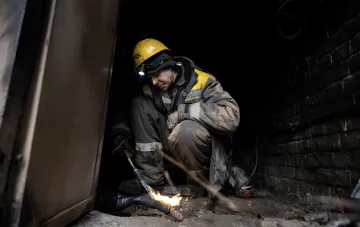
The Kyiv Metro has officially confirmed that in the event of a total power outage in the city's electrical grid, underground stations will operate as designated shelter facilities. This was reported by the Kyiv Metro municipal enterprise in response to a request from RBC-Ukraine. Life-support systems — lighting, ventilation, communications, water supply, drainage, fire alarms, and control systems — will be maintained using backup power sources. At the same time, in critical situations, train and escalator operations may be temporarily suspended.
Unified External Power Supply System and Power Maneuvering
The metro's power supply comes from the capital's energy system, and all electrical substations of the metro are integrated into a single external power supply grid. According to the enterprise, this architecture allows for power maneuvering and the deployment of backup schemes in emergency situations. With limited power supply, the metro will apply measures to reduce train frequency on individual lines or across the entire network. At the time of publication, despite the suspension of surface electric transport due to the difficult energy situation, the metro continues to operate normally.
What Stops and What Continues to Work
In critical scenarios when the voltage in the city grid disappears completely, train and escalator movements are suspended. However, as the municipal enterprise explained, life support for stations in shelter mode is provided by backup sources: «lighting, ventilation, communications, water supply and control systems, drainage, and fire alarms, upon which the life support of the metro depends — including as a shelter facility — will operate normally.» Underground stations, by definition of the enterprise, are dual-use facilities where the priority is the uninterrupted operation of restrooms, ventilation, and water supply.
Shelter Rules and Zoning Pilot Project
According to State Building Code standards and Ministry of Internal Affairs requirements, citizens during an alert can stay on underground stations with essential items and a 48-hour food supply. At the same time, bringing flammable substances and bulky items is prohibited, and the placement of mattresses or tents must not hinder the evacuation and movement of people. In August 2026, the metro tested a pilot project on four stations for zoning platforms with advisory shelter stickers. Based on monitoring results, it was established that in most cases, passengers choose places for shelter that they usually or previously used, which is why scaling the pilot project to other stations has been suspended.
Passenger Traffic and Financial Reporting
Over the 10 months of 2026, the average daily passenger volume of the Kyiv metro is 626.6 thousand passengers, whereas in pre-war 2021 this figure was 874.9 thousand passengers. The municipal enterprise also disclosed financial reporting: for the 9 months of 2026, the cost of transporting a single passenger is 54.10 UAH. At the same time, the metro emphasized that the issue of increasing the fare is not within the enterprise's competence.
Operation Mode During Air Raids
The metro recalled that during an air raid alert, traffic on the surface sections of the metro lines is suspended, while underground sections continue to operate. Underground stations provide free and unhindered access for citizens seeking shelter. Thus, even under energy restrictions and air raid alerts, the metro retains its function as the capital's transport and protective infrastructure.