In recent years, Ukraine's defense industry has ceased to be the exclusive domain of large state-owned enterprises and multi-million-dollar contracts. More and more small yet highly efficient companies are emerging in this sector, making the journey from a student workshop to mass industrial production in just a few years. One such example is Lab418, an enterprise founded by Anton Pobuta, a student at the Kyiv Aviation Institute. In an interview with RBC-Ukraine, he shared how the idea of 'preparing for the army' evolved into a systematic business producing thousands of drones a week, and why the company is not rushing into exports.
From Mavics to FPV Drones: How the Idea Was Born
Lab418's operations began in 2023 with the production of 7-inch FPV drones. According to Pobuta, they chose this category due to its low barrier to entry: all it took was learning how to solder, understanding basic radio communication principles, and grasping the general architecture of the device. 'In fact, previously you could learn how to make a decent FPV drone in a couple of weeks and hand it over to the military,' the founder recalls. Initially, the project had no ambitious commercial plan; Pobuta simply wanted to prepare for military service and learn how to fly a drone. He considered buying a DJI Mavic but found it too expensive to 'keep for himself.' The logic was simple: if the equipment was going to be handed over to the military anyway, it was better to make an FPV drone right away. 'And the first was followed by the second, the tenth, then the hundredth, and so on,' he describes the chain reaction that eventually led to the creation of the company.
The University as an Infrastructure Partner
When it became clear that production was turning into a systematic business, a practical problem arose: there was no money for rent or marketing. All initial capital went into training, purchasing components from China, and a small salary reserve for the first employees. The solution was found within the walls of his alma mater, the Kyiv Aviation Institute (formerly the National Aviation University). The university provided a workshop where Pobuta and two other engineers began their work. Subsequently, the university became a full-fledged partner: hosting exhibitions, inviting the startup to partner events, and acting as a co-organizer in the search for investments. Today, the Kyiv Aviation Institute sets up engineering laboratories and hosts events aimed at training personnel specifically for the defense industry. 'The university's involvement in our startup in particular is very high. Right now, it might be utterly crucial for people who are just starting to do something,' Pobuta emphasizes.
Scaling Up: From a Hundred a Month to Thousands a Week
At the start, the company aimed to produce about 100 drones a month. 'It was probably a very rough mistake to make calculations that way, because now we manufacture thousands of items a week, and practically those are completely different volumes,' the founder admits. The turning point for scaling came at the request of fighters from the 3rd Assault Brigade: they received a batch of several hundred drones that required ignition boards to be installed and outdated video transmitters replaced. The need to quickly service such a volume triggered active hiring. The first year of operation was characterized by extremely unstable orders—'there was work, then there wasn't'—so the team experimented with short-term employment formats and internships to retain people amidst an unpredictable flow of tasks.
HR Policy: Students in the Development Department
Today, Lab418 actively recruits students who combine their studies with work in the development department. Young engineers get paid and write their thesis projects based on real work done within the company. Pobuta emphasizes that the defense industry is experiencing an acute shortage of personnel, especially talented ones, and companies are willing to invest in training. 'If you aren't starting your own startup, you should go look for a job, an internship, or practical training. Today there is a very large shortage of personnel, especially talented ones. Companies are ready to teach, ready to deal with new personnel,' he advises students. He does not hide the fact that he was far from a model student: 'I won't say I was a very cool student who attended lectures all the time.' However, in his opinion, the combination of the university environment and practical manufacturing work yields the most effective result.
Exports and Promising Products
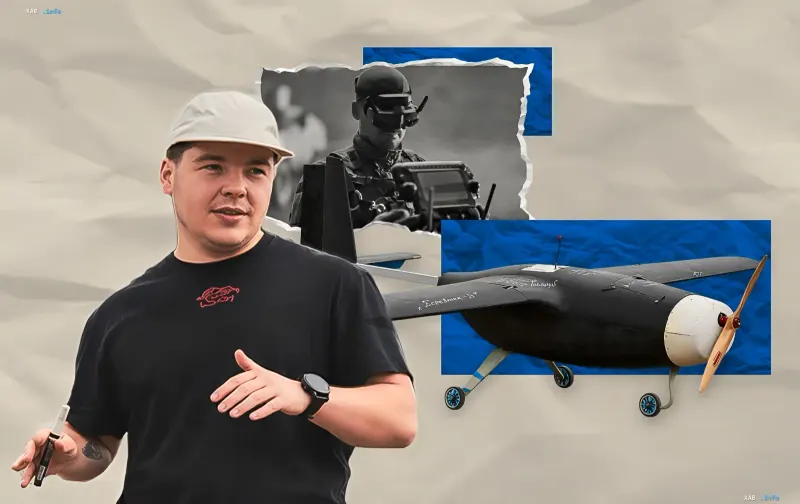
Despite high production rates, Lab418 is not rushing to export its products. In the interview, Pobuta explains that the priority remains meeting the internal needs of the Armed Forces of Ukraine and developing new solutions. The team is working on promising products that go beyond standard FPV drones, although details of specific developments are not disclosed in the open interview. The photographs accompanying the material show a serial drone with a characteristic layout: a three-blade propeller, a fixed three-point landing gear, and Cyrillic inscriptions on the fuselage—typical markings of Ukrainian combat drones used at the front. The image of an operator wearing a VR headset and holding a control tablet illustrates another vector of industry development: the transition to augmented reality systems for pilots, which is also of interest to Ukrainian developers.